

Bud Mercer was the head of security for the 2010 Vancouver Olympics, a near billion-dollar operation.
But the veteran former RCMP officer says those in charge of the World Cup in Vancouver and Toronto now face a new security landscape, from a range of global conflicts to Ebola.
"We have a war going on in the Middle East, we have a war going on in Europe with Ukraine and Russia," Mercer said. "There is economic conflict going on, as we speak. There is as well, a health crisis now in Africa. The world has changed, and when the world changes, your threat assessment changes."
Not only do the two cities face a new era of challenges, but they also occupy different security contexts. Both could help explain the high bills — and why the costs for Vancouver and Toronto look so different.
British Columbia's government has estimated security costs for Vancouver's seven matches at $242 million, while Toronto is estimating $94 million for its six games. The federal government is contributing $100 million to Vancouver's costs and about $45 million to Toronto.
Neither the City of Vancouver nor the B.C. government would share details of how the security budget is being spent, although the province said in a statement it would go to policing, fire, paramedic and emergency management responses.
But Moshe Lander, who teaches the economics of sports at Montreal's Concordia University, said Vancouver's security considerations include geography.
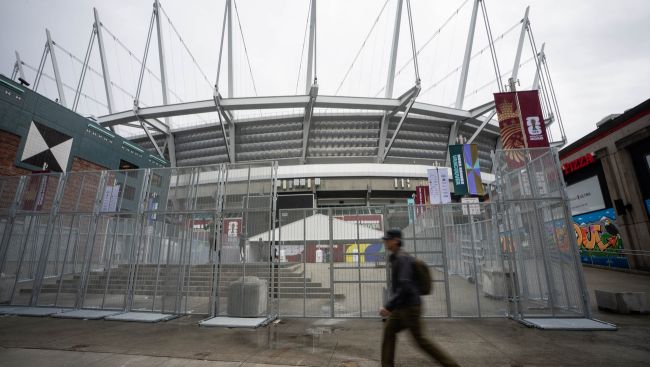
BC Place Stadium, Lander said, is not in an isolated area with nothing around it, and "a huge amount" of the cost difference of the two cities came down to stadium locations.
"So, because it is right in the middle of downtown, think about what's necessary to make sure that nothing happens to embarrass FIFA," he said. "You need increasing security cordons of varying levels radiating out from BC Place."
Officials must protect the SkyTrain, as well as major roadways near the stadium.
"So, it's going to look like you are trying to get into the Green Zone in Baghdad," Lander said.
Toronto Stadium, better known as BMO Field, meanwhile, stands on the grounds of the Canadian National Exhibition.
"So, creating those security cordons is so much cheaper," he said. "The potential disruption to subway systems, public transportation, if any of that were to happen, is going to happen miles away from the stadium itself."
Toronto Police Deputy Chief Robert Johnson said last week that his city's lower budgeted costs were attributable to a "totally different footprint" compared with Vancouver.
"We are fortunate enough to be able to have other policing partners that they don't have in B.C. Frankly, it's the Vancouver Police Department and the RCMP there," he said, while Toronto Police could rely on partners, an apparent reference to other regional forces and the Ontario Provincial Police.
It wasn't clear if Johnson was referring to the $94 million overall security costs for Toronto or the $66 million allocated to the Toronto Police Service.
Lander said overall security costs for such events had been going up, because each World Cup cycle brought more global instability, and "potential for global disruption that could embarrass FIFA people and the event."
The world, he said, "is an increasingly more dangerous place."
Among the new considerations Lander highlighted was U.S. President Donald Trump.
The World Cup could be used to stage political statements against him or other foreign governments, he said.
"So yes, the security costs are going to be substantially higher, because a lot of the chaos in the world right now is being driven by him," Lander said.
Lander said FIFA and its president Gianni Infantino actively courted Trump and fear embarrassment.
"The thing is that FIFA says to the host cities, 'we need that crown jewel protected, but we are not going to pay for it — you are,'" he said. "That's one of the costs you take on as the keeper of our product."
Another factor in high security costs was the expansion of the World Cup to 48 teams, up from 32, "which means that you have 16 more countries worth of citizens that could be coming through," Lander said.
By comparison, the final security bill for the 2010 Winter Olympics was $900 million, more than five times the original $175 million estimate.
Mercer said he didn't know details of Vancouver's World Cup security budget, or what circumstances were driving cost considerations.
But he said the biggest cost driver in such an event is paying and housing the thousands of officers and guards charged with protecting venues, athletes and fans.
"I had approximately 6,000 to 7,000 police officers in theatre (for the Olympics)," as well as 6,000 private guards, Mercer said.
"The other biggest cost driver was accommodation," he said. "Every hotel went up five times (in cost). They were hard to come by. So, we were door-knocking in Whistler, renting private accommodations, just to have a place for our security workforce to sleep. We also contracted with cruise ships to hold our security workforce."
He said a difference for the World Cup was that Olympics' athletes were mostly housed in one location, the Olympic Village. With the World Cup, players from multiple teams will be coming and going, he said.
"I think it makes (security) a little bit more complex," he said.
Both the B.C. government and Johnson with the Toronto Police said final security costs would not be available until after the tournament.
Washington state media has reported Seattle will spend almost US$32 million on hosting six games, but the B.C. government said that it did not take into account spending by other levels of government. For instance, it said the U.S. Federal Emergency Management Agency budgeted US$625 million in grants and another US$221 million for drone protection for the 11 U.S. host cities, with Seattle to receive a total of US$51.8 million in help.
The B.C. government has said overall hosting costs in Vancouver could hit $729 million, although that would be countered by about $1 billion in GDP growth over the next five years.
Lander questioned those projections.
"It's always the case that ego and vanity-driven politicians will always underestimate the cost of large-scale sporting events, and they will always overestimate the benefits," he said.
And the only way the provincial government could have avoided high security costs would have been to say No to hosting, Lander said.
"Once you sign on the dotted line with FIFA, you are stuck."
Picture Courtesy: THE CANADIAN PRESS/Ethan Cairns


