Saturday, July 4, 2026
ADVT 
National

How it started, how it ended: A chronology of Ontario's ad blitz against U.S. tariffs

Darpan News Desk The Canadian Press, 03 Nov, 2025 02:14 PM
  • How it started, how it ended: A chronology of Ontario's ad blitz against U.S. tariffs

Here is a day-by-day chronology of the controversy over Ontario's advertising campaign against U.S. tariffs on Canadian goods:

Tues., Oct. 14: The office of Ontario Premier Doug Ford says the province will spend $75 million to broadcast an anti-tariff ad in the United States using video of an address by former U.S. president Ronald Reagan, who said in 1987 that in the long run, "such trade barriers hurt every American worker and consumer."

Tues., Oct. 21: A day after the ad airs during a broadcast of a baseball playoff game won by the Toronto Blue Jays, U.S. President Donald Trump says he saw the commercial, adding "if I was Canada I'd take that same ad also."

Thu., Oct. 23: The Ronald Reagan Presidential Foundation and Institute says the ad misrepresents Reagan's remarks and that Ontario did not seek or receive permission to "use and edit the remarks."

Trump says he is ending trade negotiations with Canada over the commercial.

The ad isn't a "fake" as Trump claims, but Reagan's quotes are spliced together from different sections of the original speech. 

Ford's office defends the ad.

Fri., Oct. 24: Trump accuses Canada of "cheating" by saying that Reagan did not like tariffs, which Trump claims the late president "loved."

David McLaughlin and Geoff Norquay, who worked as senior policy advisers for former prime minister Brian Mulroney, say the ad did not misconstrue Reagan's views on trade.

Ford says his government will pull the ad after the weekend, though it's still set to run during the first two games of the World Series.

Manitoba Premier Wab Kinew encourages Ford to keep the ad campaign going, saying Trump's tariffs betray Reagan's legacy.

Sat., Oct. 25: Trump says the U.S. will impose an additional 10 per cent tariff on Canadian goods because Ontario didn't immediately pull down the ad.

Mon., Oct. 27: Ford vows he will "never apologize" for pushing back against hostile trade measures designed to poach jobs from his province.

Fri., Oct. 31: Trump says Prime Minister Mark Carney apologized for the ad but the U.S. president adds that trade talks are not resuming.

Sat., Nov. 1: Carney confirms he apologized to Trump and says he told Ford he didn't think the province should run the ad campaign. 

Sun., Nov. 2: U.S. Treasury Secretary Scott Bessent says the ad amounted to foreign interference in American public policy.

Mon., Nov. 3: Ford says Carney called him "a couple of times" from a trip to Asia to ask him to pull the ad campaign.

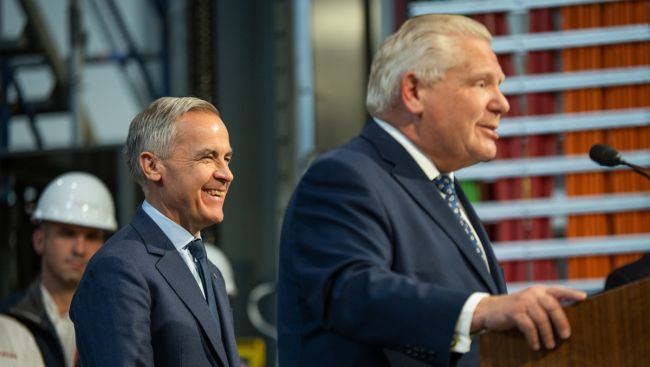
Picture Courtesy:  THE CANADIAN PRESS/Laura Proctor

MORE National ARTICLES

Federal government commits more than $160 million to Jasper recovery

Federal government commits more than $160 million to Jasper recovery
The fire-ravaged town of Jasper, Alta., has received two pieces of critical funding from the federal and provincial governments as it attempts to stabilize in the wake of last summer's devastating wildfire. The federal government announced on Thursday it's committing $162 million to the recovery in Jasper, Alta. — a portion of which is being dedicated to interim and long-term housing.

Federal government commits more than $160 million to Jasper recovery

Fast-track approval no guarantee of success for B.C. mines, researcher suggests

Fast-track approval no guarantee of success for B.C. mines, researcher suggests
The mining industry is applauding the British Columbia government's decision to fast-track permits for several projects amid the ongoing U.S. tariff threat, but research suggests economic factors have been behind long delays for many other proposals. Simon Fraser University associate professor Rosemary Collard says research shows that regulatory fast-tracking of mining projects is no guarantee that they will all materialize.

Fast-track approval no guarantee of success for B.C. mines, researcher suggests

Former human rights chief commissioner sues for defamation

Former human rights chief commissioner sues for defamation
At a press conference Thursday, Birju Dattani spoke about lawsuits he has filed against Conservative deputy leader Melissa Lantsman, media personality Ezra Levant and the Jewish advocacy group Centre for Israel and Jewish Affairs over statements made about him on social media last year. One of the defendants has called Dattani's claims "baseless."

Former human rights chief commissioner sues for defamation

Five women sexually assaulted in B.C. 'grateful' for lawsuit victory, lawyers say

Five women sexually assaulted in B.C. 'grateful' for lawsuit victory, lawyers say
Lawyers for five women who were sexually assaulted in Vancouver decades ago say their clients are grateful they won a civil lawsuit against a man acquitted of the crimes due to state misconduct. The B.C. Supreme Court awarded the five plaintiffs $375,000 each in damages from Ivan Henry for attacks in the early 1980s, in a case that set off decades of legal battles over his wrongful conviction, for which he won $8 million in his own civil lawsuit in 2016.

Five women sexually assaulted in B.C. 'grateful' for lawsuit victory, lawyers say

Liberal leadership candidates make rival defence spending pledges

Liberal leadership candidates make rival defence spending pledges
Contenders to replace Justin Trudeau as Liberal leader are attempting to one-up each other over how quickly they'd meet Canada's defence spending commitment to NATO. Both Chrystia Freeland and Karina Gould vowed Thursday to bring Canada's military spending up to the equivalent of two per cent of national GDP by 2027 — five years ahead of Trudeau's timeline and three ahead of rival candidate Mark Carney's plan.

Liberal leadership candidates make rival defence spending pledges

One in five recent Canadian immigrants lived below poverty line in 2022, says StatCan

One in five recent Canadian immigrants lived below poverty line in 2022, says StatCan
StatCan says a family or a person lives in poverty if they can't afford the cost of a basket of goods and services that represents a basic standard of living. They are in deep poverty if their income falls below 75 per cent of that threshold.

One in five recent Canadian immigrants lived below poverty line in 2022, says StatCan