Canada’s publicly-funded universal health care is often regarded as one of the most important and appreciated accomplishments of the nation. However, every coin comes with two sides, and recently, the province of BC, specifically, has been under scrutiny for continued delays in the healthcare system. Given that multiple incidents, including cancer treatment and screening delays, are being reported, the issue is a pressing one.
While the Ministry of Health points out that urgent and emergent scheduled surgeries are able to proceed, non-urgent scheduled surgeries have been postponed, most recently as of December 21, 2021, when Minister of Health, Adrian Dix, and Provincial Health Officer, Dr. Bonnie Henry made this announcement. In terms of steps being taken to resolve the issue, the Ministry of Health asserts that surgical renewal efforts have been consistent and deliberate. Between March 16, 2020 and January 29, 2022, the province has completed 578,327 scheduled and non-scheduled surgeries. In a single week (January 23-29, 2022, for example), 6,028 surgeries were completed. This is compared to 837 postponements for the same period. In fact, data shows that only 320 non-urgent scheduled surgeries were postponed between February 6, 2022 and February 12, 2022.
Earlier in the pandemic, the Ministry of Health did make a surgical renewal commitment to patients to get them their postponed surgeries, to get more surgeries to more patients faster, and to change the way we deliver surgeries in BC. From the Ministry of Health’s office, Krystal Thomson, Manager of Government Communications and Public Engagement details, “Since making that commitment, we have delivered surgeries to 99.7% of the patients whose surgeries were postponed from March to May in 2020, and who wished to still proceed with surgery. We have also delivered surgeries to 93.7% of the 3,321 patients whose surgeries were postponed between October 2020 and January 2021, and from March 2021 to June 2021, and who wished to still proceed with surgery. In terms of screening delays, our medical imaging delays are actually down January 2021/2022 compared to January 2019/2020. It should also be noted that most cancer surgeries would be considered urgent or emergent and therefore have not been postponed.”
That said, due to rising COVID-19 cases, surgeries have had to be postponed once again in the winter season. However, those patients remain part of the Ministry of Health’s Surgical Renewal Commitment. The current frame of reference is undoubtedly an example of a time period where there has been increased pressure from COVID-19 on the health-care system. Because of the general efforts to push back against COVID-19, health authorities have been able to again start booking and completing surgeries that were postponed, where it’s safe to do so. “We added time in the public system for surgery, we added hours at the beginning or the end of days, we added weekends to surgery slates in order to address both those backlogs and to reduce surgical wait times in certain areas,” says Minister Adrian Dix. Surely, this is the result of the hard work and dedication of BC’s many health-care workers, who are working tirelessly to ensure quality health-care is still available despite immense challenges due to COVID-19.

However, although the province may be on track to make its recovery for health care delays, the issue is really a deep-rooted one, existing well before the pandemic and one that will remain after the pandemic too. Speaking from his experiences and viewpoints as an individual Family Physician practicing in the City of Burnaby, Dr. Baldev Sanghera shares that the problem may seem to be complex, but can be broken down for smoother understanding. While the pandemic has taken the major focus of the healthcare arena and has been using most of its resources, the system was already running beyond 100% pre-pandemic. While normal businesses may have responded to pandemic-related challenges by simply hiring more staff, the health care system was already maxed out and could not respond by just adding more resources than it could safely handle.
Therefore, the solution was to move staff around, which meant putting off elective surgeries. While delaying elective surgeries may have resulted in prolonged suffering, the impact is not fatal, whereas necessary surgeries cannot be postponed as one would otherwise face death or irreparable harm. Thomson elaborates, “The reason for significant healthcare capacity issues at the moment is increased COVID-19 hospitalizations. Because we are having to manage resources with the rise of COVID-19 patients, this means other less urgent items are being affected. The greatest example of this is the postponement of non-urgent scheduled surgeries, to allow for emergent and urgent surgeries to proceed.”
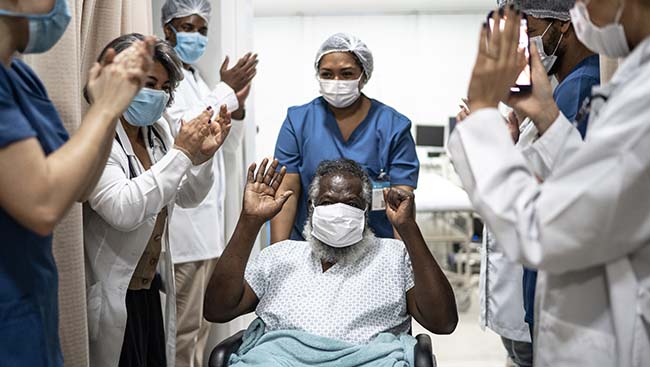
On the acute care side, since each wave of the COVID-19 pandemic has been bigger than the previous one, waitlists for surgical, screening, testing, and other procedures have gotten even longer. Not only has the sheer number of COVID-19 patients requiring care increased, but nurse and doctor availability is also at capacity. Moreover, tests have had to be delayed until the risk of transmission is gone from resources utilized by COVID-19 patients. On another front, post-surgery recovery beds are also required after a surgery has taken place. If ICU beds are filled with COVID-19 patients, then elective surgeries have to be avoided as post-surgery beds are simply not available. Evidently, given that there is a shortage of staff and resources, building more buildings isn’t the resolution, as one may otherwise resort to thinking.
From a community perspective, Dr. Sanghera reveals that family physicians have always been overwhelmed and working more than they should. He further details, “The average family physician is working between sixty to eighty hours a week. Given the pandemic and increased strain on the healthcare system, if you give them even more work, it physically becomes extremely difficult to fit all that in. Then, you have to keep prioritizing access. Depending on the workload, you deal with whoever is sickest.” Dr. Sanghera says that while in large offices like his, delegations and team work is possible because there is enough staff, it can be extremely difficult for smaller, community clinics to pivot through the increased demand. He points out that the truth is that we just don’t have enough family physicians.
Why are family physicians so important? Well, family physicians develop longitudinal relationships with patients, coordinating general and acute need care for a group of patients that are attached to that specific practitioner. When you’re attached to a family physician, they truly understand your health care needs inside out. Consequently, this enables the prevention of health problems through proactive care. When you’ve got an attached family physician, then your health, in general, will be much better. Aside from guiding people with prevention, family doctors also help navigate the healthcare system. A family physician’s job is to help advocate for families. However, unattached practices do not have that advocacy piece. Moreover, when the focus shifts on following guidelines of health authorities where one wrong move can risk the job contract, advocacy can be difficult to uphold.
Given these overwhelming subsets of challenges, family physicians in BC have been feeling undervalued and undersupported by the system, with some choosing to quit. Dr. Sanghera outlines, “In Burnaby, we have lost about eight physicians in the last year, and there isn’t much planning happening to address that. There has been a population boom after World War 2, and all those baby boomers are now in their 50s, 60s, and 70s. That population group needs extra care. On the other hand, in the next three to five years, we will see 20% of our physician workforce retire. We will see another massive drop off with boomer physicians retiring, as boomers need more care.”
Governmental organizations may counter the argument by stating that the province does have many physicians, but a notable portion of those physicians work for corporations and hospitals, and aren’t true family doctors who are doing the work to keep the general population healthy. Digging deeper, there are an array of factors. Dr. Sanghera brings forth an interesting point about not enough medical students being trained, “We have trained 288 people, but we have retired 400. Every year, we fall further behind.” Of those that are trained, many students choose to become specialists, given that family physicians usually have an unhealthy work-life balance and are comparatively paid less.
Arguably, as family physicians tend to be more community-minded, have a nurturing approach, and have the desire to look after people, the group that carries the biggest load is currently the least paid. From a monetary viewpoint, family physicians earn less in BC than they do in other parts of Canada like Ontario, on average. Furthermore, with licensing so slow that even immigrant doctors give up during the process, there is a need for quick, robust ways to license qualified physicians. If the key lies in having enough family doctors, professionals who are trained but not working must be recruited and supported.
Of course, given that the causes for the overall delays are spread out in so many facets of the system, the responsibility sits with everyone. Besides fair pay, medical students going into residency need to have more positions funded in places other than hospitals. Medical programs need to be connected with family doctors; once students get exposed to the compassionate way of delivering care in the community, they will want that satisfaction of seeing the same patient again, rather than being biased to working in hospitals as that has been their only exposure during as residents. Training also needs to extend to the human resources sector, as more x-ray technicians, bloodwork technicians, lab technicians, and nurses are needed, alongside family doctors and specialists. More capacity must be built.
As part of the system-wide approach, public pressure should be applied starting with local MLAs and the Ministry of Health. Funding that has otherwise usually gone into unionized places for improvements should be utilized for improving the health of all of society, which may even require creative solutions. Dr. Sanghera suggests, “Cities can play a role, by starting to do some planning when they are approving building permits. We need to encourage local and civic politicians. If a 50-story building is being established in a neighborhood, maybe there needs to be a request built in for the developer to integrate public services like a doctors’ clinic. We have to explore out-of-the-box thinking.”
At the patient and individual level, it is obvious that anger will not get people anywhere. Not just at the doctor’s office, but also generally, people will naturally get more support if they are nicer. Dr. Sanghera reminds the general public that doctors are trained professionals who are on your side and who do want to nurture you. It is also vital to note that changemakers are not necessarily those in official or authoritative positions of power, but also citizens who join committees and ensure that they are represented in the best possible way.
Even if you are not involved hands-on, you can play your part by taking care of your own health. After all, prevention is cheaper than cure. As Thomson from the Ministry of Health advises, “Follow public health orders. By getting vaccinated and staying home when you’re not feeling well, you are doing your part to ensure you and those around you don’t get sick and may need hospitalization. If we all follow public health guidelines, which are designed to protect us and our healthcare system, we can each do our part to protect our healthcare system.” Even beyond the COVID-19 pandemic, a proactive approach to implementing a healthy lifestyle can result in better choices and better results. The community needs to hold hands with an interconnected approach, where we do hold decision-makers accountable for system-wide decisions, but also take responsibility for our own health.