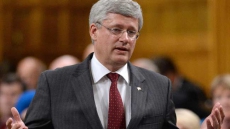
OTTAWA - Prime Minister Stephen Harper's sweeping new package of family tax cuts will chew through billions of dollars of the government's projected budgetary surplus.
But it remains to be seen just how much cash will be left over — if any — once Ottawa introduces its tax-relief package for families.
Harper says he still anticipates running a small deficit this year and a small surplus next year, despite the "significant" cost of the tax-cutting measures announced today.
TD senior economist Randall Bartlett says even though the tax relief will be expensive, he believes there will be enough surplus room in the federal piggy bank to pay for it — but it will be close this year.
Bartlett says TD's projection of a $5-billion surplus for this year will essentially be wiped out — especially when the risk of persistently low oil prices is factored in.
The Finance Department estimates the combined tax cuts announced today will reduce Ottawa's bank account by an average of $4.4 billion annually over six years — for a total of just under $27 billion.
The missing piece of the puzzle of how much Ottawa expects its projections to change as a result of the cuts will have to wait for the government's upcoming fall economic update.
Health spending up only $61 per person in 2014
Thu, 30 Oct 2014 21:11:11 GMT
TORONTO - The cost of health care in Canada will go up this year, but the increase is expected to be the smallest in the past 17 years, a new report suggests.
The report on health-care spending in Canada estimates that total health expenditures will rise by only 2.1 per cent, or $61 more per person compared to last year's health costs.
Spending on drugs has flattened out. And concerns about the cost of a greying population on the health system aren't currently driving costs up in a significant way, according to the report from the Canadian Institute for Health Information.
At this point, the institute says, population aging is only increasing costs by just under one per cent per year — 0.9 per cent. The trend is expected to change incrementally over the next two decades, the CIHI report says.
"While concerns regarding demographics are understandable — Canadians over the age of 65 account for less than 15 per cent of the population but consume more than 45 per cent of provinces’ and territories’ health-care dollars — the share of public-sector health dollars spent on Canadian seniors has not changed significantly over the past decade," Brent Diverty, CIHI's vice-president for programs, said in a press release.
The report notes that in 2012, per person spending for seniors ranged broadly, from $6,368 per person for those aged 65 to 69 to $21,054 per person per year for those aged 80 or older.
The low end of that scale isn't far off what the report says Canada will pay per person in general in 2014, $6,045.
Canada is expected to spend just under $215 billion this year on health care, which equates to 11 per cent of the country's gross domestic product.
That spending level puts Canada tied for seventh with Denmark among the countries of the Organization for Economic Co-operation and Development, the OECD. Canadian spending trails that of the United States, the Netherlands, France, Switzerland, Germany and Austria.
The public purse picks up about 70 per cent of the cost of health care in Canada. The remaining 30 per cent comes from out-of-pocket payments by individuals and private health insurance. That 70-30 cost breakdown has been relatively constant over the past 20 years, the report says.
Hospitals make up about 30 per cent of health-care spending, $63.5 billion. Drugs and doctors come next, at 16 and 15 per cent respectively, or $33.9 billion and $33.3 billion.
Drug costs, once a major driver of expenditure increases, have stabilized, growing by only 0.8 per cent in 2014, the report says.
"Drug expenditures are slowing down," Diverty says. "With generic pricing control policies for the pharmaceutical industry, the expiration of patents on prevalent medications and fewer new drugs entering the market, we are seeing what amounts to flattened growth."
The three territories, which often have to fly residents south for medical care, spend substantially more per person than provinces do. Nunavut will spend the most, at just over $13,160 a person, while Quebec is expected to spend the least, at $5,61