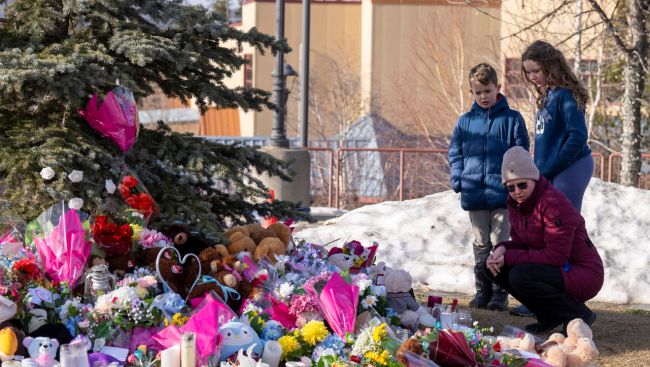
As news and social media coverage of Tuesday's mass shooting in Tumbler Ridge, B.C., continues to blanket the country, parents should be proactive about talking with their kids about the tragedy, psychologists say.
The fact that it happened at a school hits especially close to home, said Dr. Jo Ann Unger, a clinical psychologist in Winnipeg.
"Whenever we can see ourselves or can relate to something very difficult or tragic that's happened, it naturally creates a larger response," she said.
"Children seeing that other children have been killed, have died, that can certainly cause us feelings of empathy and sadness and grief," Unger said.
"Some kids, when they have that tendency towards some anxiety and fear, may have some worries about their own safety."
Here are some tips from Canadian psychologists about how to talk to help your kids and teens cope with the tragedy.
FACE YOUR OWN FEELINGS
Dr. Tina Montreuil said parents need to come to terms with their own feelings about the tragedy first.
"I think it's really important right now in the next hours and days that we don't avoid it and that we process these events," said Montreuil, an associate professor of educational and counselling psychology at McGill University.
”I think the worst thing that we could do as parents is sort of transfer our own lack of processing of the event and the emotions that it generates in us — fear, uncertainty, insecurity," she said.
"We want to address this before we speak to our children so that we don't make them feel unsafe."
Unger suggests parents talk about their feelings and worries with their partner, adult family members or friends so that when they talk to their kids, they can "do so in a really calm and regulated way."
LISTEN AND OFFER PERSPECTIVE
Listening and validating kids' thoughts and feelings is the first step, said Unger.
Doing a "neutral check-in" is helpful to avoid making assumptions about what they're thinking and feeling so you can hear what's truly going on with them, she said.
Montreuil said starting by asking kids what they know about the shooting provides an opportunity to correct any misinformation.
If your child or teen is feeling frightened about going to school, it's important to acknowledge that fear and then ”very gently and kindly provide as much factual information that we can about what things are in place that do keep them safe," said Unger.
It's important to be truthful, she said.
"We can't say to them, 'Well, this will never happen to you,' and then they can answer back, 'Well, it happened to somebody,'" Unger said.
But at the same time, parents can put the fear in perspective by noting how rare school shootings are in Canada, she said.
Dr. Margaret McKinnon, a mental health and trauma researcher at McMaster University, said parents can reinforce that schools are generally safe places.
McKinnon said it's important for parents to "use plain language and concrete terms" in these conversations.
WATCH FOR SIGNS OF MENTAL STRESS
Younger children may not express all of their feelings verbally, McKinnon said, but their behaviour can be telling.
"It won't necessarily be speaking, but things like disrupted play, maybe (it's) more fighting or arguments," she said.
"So sometimes it's what children say, but it's also what they do as well when they're feeling upset or worried."
Unger said other behaviour changes that can signal mental distress in kids and teens include difficulty sleeping, not being able to concentrate, changes in eating, isolating themselves or not doing the activities they usually enjoy.
"Sometimes, it can even come out as irritability, as opposed to what we would be able to easily name as fear or anxiety," Unger said.
”If we see some of these signs, then we might be a little bit more assertive in our check-in," she said.
Parents can say they've noticed the change in behaviour and ask if something is troubling them and offer to listen and help.
If your child or teen continues to struggle, feel deep sadness or fear, or can't stop thinking about the shooting after a couple of weeks, parents may want to seek additional support through school, a primary-care provider or mental health professional, Unger said.
MAINTAIN ROUTINES
”Routine is really stabilizing and combats that sense of stress or that sense of unknown or that sense of fear," said Unger.
"We're still going to go to school, we're still going to get up, we're still going to have meals at the same time, we're still going to keep doing activities, even though this terrible thing has happened," she said.
"(That) can really help us manage that stress level."
TAKE ACTION
Taking concrete action can combat the feeling of helplessness after a traumatic event, psychologists say.
"Research shows that when we can take some action and when we can show some kindness and compassion in the world, it actually helps our mental health as well as the people we're supporting," Unger said.
Those acts of kindness could be specifically directed to the community of Tumbler Ridge, or they could benefit your own community in their honour.
Kids could write cards and letters to people in Tumbler Ridge, or organize fundraising events for them, Unger said.
They could also fundraise for organizations closer to home that help families deal with grief or support mental health.
Montreuil said getting youth to identify actions they can take can be "very valuable."
”The best way to overcome the lack of safety, feeling insecure and feeling like a victim ourselves, even though this is kind of distant from us, is to get youth to do something," she said.
That could be anything from holding a town hall in school to talk about feelings arising from the tragedy to doing an art project to honour the community of Tumbler Ridge and posting it on social media, Montreuil said.
Picture Courtesy: THE CANADIAN PRESS/Christinne Muschi