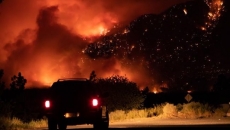
Former Xatsull First Nation chief Bev Sellars recalls an emergency meeting after the Mount Polley Mine disaster, where elders were in tears as they thought of fish swimming through the toxic waste that had inundated their territorial waters.
She thinks of the 2014 disaster often.
"There are physical changes you can still see," Sellars said. "There's still things happening in the lake."
The catastrophic collapse of a tailings dam in the B.C. Interior sent about 25 million cubic metres of poisoned water from the copper and gold mine surging into waterways including Polley and Quesnel lakes on Aug. 4, 2014.
The impact is now filtering though the legal system, with 15 federal Fisheries Act charges laid last week against Imperial Metals Corp. and two other firms.
The environmental impacts are still being felt too, scientists fear, with toxic particles swirling in Quesnel Lake's water a decade later.
Research also shows tiny invertebrates that form the basis of the aquatic food chain displayed elevated metal accumulation at sites affected by the spill, suggesting material from the disaster was proving potentially toxic to the creatures for years after the initial breach.
Greg Pyle, an aquatic eco-toxicologist and professor emeritus at the University of Lethbridge, was behind that research. He started studying the effects of the disaster on both Polley and Quesnel lakes about four years after it occurred.
"I spent my entire career around some of the most contaminated sites in the country and this was one of them," Pyle said.
He and his team published their research in 2022, detailing metal accumulation and toxicity in freshwater scuds — an insect-like arthropod — and mayfly larvae from sediments affected by the spill.
"The reason why we were going after these bugs, these invertebrates, is because they sit at the base of the food chain," Pyle said. "They make up a significant portion of smaller fishes' diet. The small fish comprise the larger fishes' diet and so on up the food chain."
Their study showed elevated toxicity in samples of the creatures collected near the disaster site compared with those from "clean far-field" sites.
Quesnel Lake, Pyle said, was particularly "dynamic."
"It's a big lake," he said. "There are places where I would have no problem eating the fish out of there. Would I do it right over where there’s been a massive copper mine breach? Probably not."
Copper, he said, is known to be a "powerful neurotoxicant to fish and other aquatic animals."
Pyle said he's still interested to know whether exposure to copper from the spill was damaging the sense of smell for fish.
"I was concerned that these animals would have an impaired sense of smell and consequently they'd have a difficult time finding food, finding mates, avoiding predators or even migrating," he said. "That's one of the things that we never had an opportunity to test."
"We don't know whether or not that happened," he said.
Ellen Petticrew, a geography professor at the University of Northern British Columbia, said that after the disaster, researchers quickly began looking into the effect on Quesnel Lake, "the deepest fiord lake in the world."
She and colleague Phil Owens, an environmental science professor, were able to quickly access areas near the disaster because the university had a research station set up nearby.
Fine particles of sediment contaminated with copper and other metals, "stayed in suspension for months and then it slowly sort of rained down to the bottom of the lake," Owens said.
But the lake's waters turn over twice a year, stirring up contaminated sediment that gets suspended again, which runs "counter" to what the mining company and consultants believed at the time.
"They thought that the tailings would just stay at the bottom of the lake and be immobile, but actually that has not proven to be true, and we still detect that 10 years later," Owens said.
Petticrew said the lake's waters swish like "rocking in a bathtub," and their research focused on the movement of contaminated material "up into the food web to the point of the fish food, but not to the fish itself."
She said the mining company has studied toxicity in fish tissues, but the research made available online hasn't been easy to access and assess.
"We've looked generally to try to find it," Petticrew said. "Their website feels like it's meant to confuse you and make it problematic. It's not like it's very straightforward to get access to the stuff that they say is fully available."
Imperial Metals said in a written statement that because it's been served with the Fisheries Act indictment, it wouldn't be commenting further on the charges.
Petticrew said the trouble with pinning down toxic effects in fish isn't easy.
"So much of what happens to salmon is unexplained, whether it's in the ocean, whether it's on the route up because of temperature, whether it's because of a Big Bar blocking the way, whether it's because of contaminants in the water column," she said, referring to the Big Bar landslide in 2019 in the Fraser River that created a large waterfall that trapped the fish.
"There's so many different variables that affect the return of salmon that nobody's been able to pin anything on this."
Fishing in Quesnel Lake is still robust, and the Mount Polley mine disaster now "seems to be a far distant memory," said Marita Boxrud, owner of the Plato Island Resort, located far upstream from the tailings breach.
"Fishing has been good. Lots of lake trout and rainbow trout have been caught and released," she said. "It was an unfortunate accident, but we think that the company did a fantastic job cleaning up and supporting the community."
Craig Orr, a conservation adviser with the Watershed Watch Salmon Society and an adjunct professor in the Faculty of Environment at Simon Fraser University, said he was unaware of the most current information about Mount Polley's long-term effects on waterways.
Orr said the Quesnel river system is crucial to salmon runs through to the Fraser River, into which it flows, and he was more involved in assessing the disaster's short term impacts as the society's executive director at the time.
"We just have to look at the state of Fraser sockeye. Every impact is something that we try to avoid right now," he said. "We've had some of the worst returns on record this past year for Fraser River sockeye."
He said wild salmon runs are affected by industrial activities, including forestry and salmon farming, and the poor returns in the Fraser have been compared to a "death of a thousand cuts."
"The Mount Polley mine breach was more than a cut," he said. "It was a hammer blow to Quesnel sockeye."
Two weeks after the disaster, the B.C. government announced a partnership with both the Williams Lake and Xatsull First Nations.
The statement announcing the partnership quoted then-chief Sellars saying the deal would allow "First Nations and the provincial government to begin a necessary conversation about the adequacy of existing laws, regulations and policy in regards to the overall mining sector in British Columbia."
Ten years later, Sellars said the provincial government still treats the mining industry with deference, handing out permits to individual projects "without looking at the cumulative effects."
"In order to sustain a healthy economy, we need a healthy environment," she said. "Otherwise it's all gonna catch up to everybody one day."