

It doesn't end up on dinner plates and it lacks the popular appeal of whales and dolphins, but scientists warn that a small fish that is critical to Arctic marine life could be in trouble from climate change and human activity.
Maxime Geoffroy, a researcher at the Fisheries and Marine Institute of Memorial University of Newfoundland, said the fate of the Arctic cod — also known as the polar cod — has a ripple effect on animals such as beluga and bowhead whales and ringed seals.
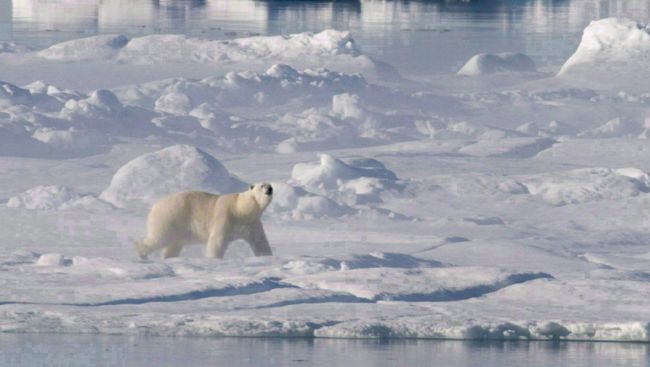
"Polar bears for instance, which are one of these charismatic Arctic animals, they feed on seals that rely on Arctic cod. So it's not a direct impact on polar bears, but it will have a detrimental impact," Geoffroy said in an interview.
"Tourists are not coming to the Arctic to see the Arctic cod, but they are coming to see the predators that are feeding on polar cod. It will have a cascading impact on the whole Arctic ecosystem as we know it."
Geoffroy and a consortium of dozens of international scientists sounded the alarm on the fate of the fish in a scientific review published this month in the journal Elementa.
Changing weather conditions are causing habitat loss, disrupting reproduction, hampering food availability for larvae and juveniles and leading to increased predation as some species migrate north to escape warming waters, he said.
The Arctic cod is not fished commercially but it is the most abundant forage fish in the Arctic seas, providing a key food source for other marine life. It spends its early life close to ice-covered and open water surfaces eating zooplankton, while adults seek out ocean depths of up to 100 metres. It belongs to the Atlantic cod family and measures less than 25 centimetres with a lifespan of under seven years.
There are a few other larger species of fish found close to the Arctic floor, but they are not as plentiful, and most of them also feed on the Arctic cod, Geoffroy added.
Models show that warming waters could decrease the population by 17 per cent by 2050, he said, which could mean a significant loss of food for about half of the animals that depend on the cod, he said.
The cod eggs do best at sea temperatures around freezing, while larvae tolerate up to 2 C. Anything warmer is "detrimental" to the animal, he said. Some parts of the Arctic Ocean are seeing temperatures near the surface, where most young Arctic cod live, above 2 C, he said.
"But it's not dire everywhere," he pointed out.
The Arctic cod is at its outer limit of tolerance along the southern boundary of its range — in the Bering, Labrador, and Barents seas, he said. But it is in comfortable conditions in the High Arctic, such as the Canadian Arctic Archipelago, the Siberian Arctic, and the Arctic Basin, he said.
Most of the planet is covered by oceans, which have absorbed 90 per cent of the recent warming caused by planet-warming gases such as carbon dioxide and methane. Global sea surface temperatures have been at record highs since April, meteorologists report as climate change is linked to more extreme and deadly events.
Newly published data from the Copernicus Climate Change Service documented "exceptionally warm'' ocean temperatures in the North Atlantic with "extreme'' marine heat waves near Ireland, the U.K., and in the Baltic Sea.
Compounding the effects of climate change is human activity. "I think what we saw was that the main risk was really from oil pollution, rather than fisheries," Geoffroy said.
Young Arctic cod exposed to crude oil show reduced survival and growth as well as greater deformities, he said.
And without enough healthy species to carry on, he said the food web could be in trouble. He likened the Arctic cod to a “key piece of the Arctic puzzle," which if removed would leave a significant hole. "The cascading impacts, again, they will have an impact on the whole ecosystem."


