OTTAWA — Stephen Harper and his defence minister made it clear Thursday they won't tie the hands of Canadian military trainers in Iraq, but also suggested Canada's combat mission isn't expected to escalate further.
The issue of when and how special forces began guiding airstrikes for mostly Kurdish forces came into sharper focus with statements from Defence Minister Rob Nicholson and Gen. Tom Lawson, the country's top military commander.
When the deployment of up to 69 elite Canadian troops was approved last September, officials understood there was a chance they could end up spotting targets for the U.S.-led coalition's air campaign, Nicholson suggested.
"We didn't put limits on their ability to advise and assist the Iraqis," he said via conference call from London, where coalition members were meeting. "The special forces were there to provide advice and assistance, and that's what they've done."
Lawson, who has been pilloried for saying in October that troops would not carry out such pinpoint targeting at the front, said the war in Iraq had "evolved" since then, adding that the special forces "are not seeking to directly engage the enemy" through offensive operations.
It was left to Harper to hammer home the point, saying that he does not anticipate a greater combat role for Canadians.
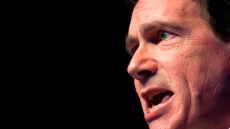
"The government's position is: We want to help. We want to advise; we want to assist Iraqi forces — particularly the Kurdish forces — to lead the combat themselves, and that's what they are doing," Harper said at an event in St. Catharines, Ont.
"Let me be clear: This is a robust mission. We're there to make those guys effective so they can take on the Islamic State and deal with them. And if those guys fire at us, we're going to fire back and we're going to kill them, just like our guys did, and we're very proud of what they're doing in Iraq."
The government has made a point of blurring the distinction between the legitimate right of soldiers to defend themselves when fired upon, and the evidently broader mandate of special forces assisting airstrikes — something that other countries have been either unwilling or unable to do.
Canada, the U.S. and other nations have ruled out putting conventional army troops on the ground, but defence experts say those countries could escalate the role of special forces if they choose by allowing them to conduct commando-style raids ahead of Iraqi and Kurdish forces when they go on the offensive.
The Iraqi government, throughout the fall, pressured the U.S.-led coalition to step up the bombing campaign to help contain Islamic State extremists as they overran swaths of the country's north and west.
At a news conference in London following Thursday's meeting, Iraq prime minister Haider al-Abadi noted the increase in "not only the number, but the effectiveness" of airstrikes. Even still, he urged his allies to do more.
The commander of Canada's special forces, Brig.-Gen. Mike Rouleau, said earlier this week that his troops have guided 13 bombing missions from the front lines since the end of November.
National Defence has held several briefings since then, but never revealed the expanded role, which Rouleau denied was an escalation.
Both opposition parties say the government has had plenty of opportunity since the special forces mandate was widened to come forward and be frank about what they were doing.
And both the Liberals and NDP are viewing the government's latest assurances about no further escalation with a lot of skepticism.
"You have to ask yourself: Is our leadership being honest with Canadians about what our men and women are being asked to do?" Liberal defence critic Joyce Murray said. "The answer is no, they're not."
NDP defence critic Jack Harris said the public has to be able to trust what it's being told, especially by its military leadership.
Between Nicholson, who said guiding airstrikes was always a possibility from the beginning, and Lawson, who ruled them out in October, Harris said he's not sure whom to believe.
Meanwhile, the London meeting of 21 countries involved in the fight against the Islamic State of Iraq and the Levant covered a broad range of issues outside of the military campaign, which has been the main focus of the Harper government's public comments.
Nicholson reiterated how much humanitarian aid Canada has contributed, and spoke in general terms about allied efforts to cut off the flow of funds and foreign fighters bound for the battlefields of Iraq and Syria.