
Wednesday, May 13, 2026
ADVT 
National

India, Canada agree to boost energy cooperation

Darpan News Desk IANS, 27 Jan, 2026 01:39 PM
  • India, Canada agree to boost energy cooperation

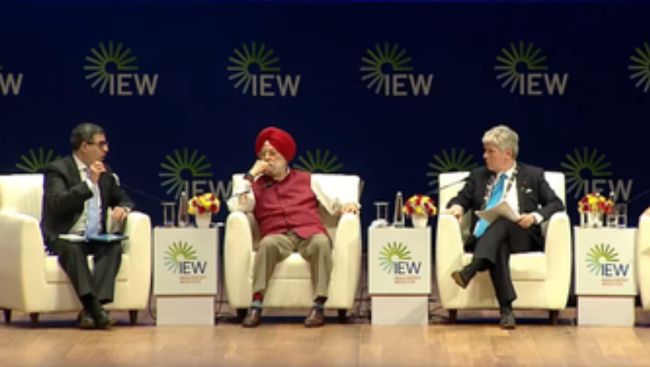
India and Canada on Tuesday signed a joint statement to strengthen cooperation in the energy sector during the India Energy Week 2026 held in Goa.  

The agreement marks a renewed push to deepen bilateral ties in areas such as oil, gas, clean energy and long-term investments.

The joint statement followed a bilateral meeting between India’s Minister of Petroleum and Natural Gas, Hardeep Singh Puri, and Canada’s Minister of Energy and Natural Resources, Timothy Hodgson.

Hodgson’s participation at India Energy Week 2026 was significant as it marked the first time a Canadian Minister attended the event.

During the meeting, both ministers formally launched the renewed India-Canada Ministerial Energy Dialogue.

They stressed that energy security and diversified supply chains are critical for the economic growth, safety and overall well-being of both countries.

The meeting was held in line with the direction given by the Prime Ministers of India and Canada during their interaction on the sidelines of the G7 Summit in June 2025 in Kananaskis, Canada.

At that time, both leaders had underlined the need to restart senior-level and working-level engagements between the two countries.

India and Canada acknowledged that their energy sectors complement each other well. Canada aims to become a global energy superpower in both clean and conventional energy, with a strong focus on expanding exports.

India, on the other hand, is emerging as a central player in the global energy market due to its large and growing demand.

Canada highlighted its expanding capabilities in liquefied natural gas, crude oil, and liquefied petroleum gas exports, especially to Asian markets.

India noted that it is the world’s third-largest oil consumer, fourth-largest LNG importer and third-largest LPG consumer, with one of the largest refining capacities globally.

India is also expected to account for more than one-third of the growth in global energy demand over the next two decades.

Both sides agreed to deepen bilateral energy trade. This includes the supply of Canadian LNG, LPG and crude oil to India, as well as the supply of refined petroleum products from India to Canada.

The ministers also expressed interest in encouraging stronger commercial and investment partnerships in each other’s energy sectors.

Canada shared that it is fast-tracking major energy and resource projects, supported by over $116 billion in investments announced in 2025.

India, meanwhile, highlighted policy reforms and investment opportunities worth around $500 billion across the entire energy value chain.

Picture Courtesy: IANS

MORE National ARTICLES

Heiltsuk Nation written constitution passes with 67 per cent of votes

Heiltsuk Nation written constitution passes with 67 per cent of votes
The Heiltsuk Nation has approved the adoption of a written constitution for the First Nation on British Columbia's central coast. The nation says 67 per cent of the 725 people who voted on the referendum were in favour of the constitution.

Heiltsuk Nation written constitution passes with 67 per cent of votes

Poilievre's proposed incentives for First Nations water, resource projects draw fire

Poilievre's proposed incentives for First Nations water, resource projects draw fire
Conservative Leader Pierre Poilievre says he would incentivize First Nations to support natural-resource projects through industry taxes and revisiting how much sway Indigenous Peoples and environmental considerations have over approving projects.  The proposals drew swift criticism from some experts and researchers.

Poilievre's proposed incentives for First Nations water, resource projects draw fire

Indigenous kids in care more likely to experience poor health later in life: report

Indigenous kids in care more likely to experience poor health later in life: report
Indigenous people who were in government care as children experience poorer health and socioeconomic outcomes later in life than those who were never in care, a new Statistics Canada report says. They suffer higher rates of disability, lower self-rated health levels and more homelessness, and are more likely to struggle to meet basic household needs, the report says.

Indigenous kids in care more likely to experience poor health later in life: report

Ex-coroner says B.C.'s drug policy overhaul looks like 'impulsive political decision'

Ex-coroner says B.C.'s drug policy overhaul looks like 'impulsive political decision'
British Columbia's former chief coroner says she's disappointed by the province's overhaul of its program that provides prescription alternatives to toxic street drugs, a shift she says "feels like a really impulsive political decision." Lisa Lapointe said the move to a "witnessed-only" model in which people are supervised while consuming their prescription drugs appeared to ignore scientific evidence.

Ex-coroner says B.C.'s drug policy overhaul looks like 'impulsive political decision'

Internal military report blames botched shooter drill on poor organization

Internal military report blames botched shooter drill on poor organization
During the drill, which took place on Nov. 12 at a service depot at CFB Longue-Pointe in Montreal, military police also confused a racialized employee with a drill participant playing an active shooter and wrestled him to the ground.

Internal military report blames botched shooter drill on poor organization

70% of Canadians support retaliatory tariffs on United States: poll

70% of Canadians support retaliatory tariffs on United States: poll
Seventy per cent of Canadians are in favour of dollar-for-dollar retaliatory tariffs on the United States, a new poll suggests. Nearly half of respondents to the Leger poll — 45 per cent — said they were strongly in favour of such tariffs, while 25 per cent said they were somewhat in favour.

70% of Canadians support retaliatory tariffs on United States: poll