
Thursday, May 14, 2026
ADVT 
National

India, Canada agree to boost energy cooperation

Darpan News Desk IANS, 27 Jan, 2026 01:39 PM
  • India, Canada agree to boost energy cooperation

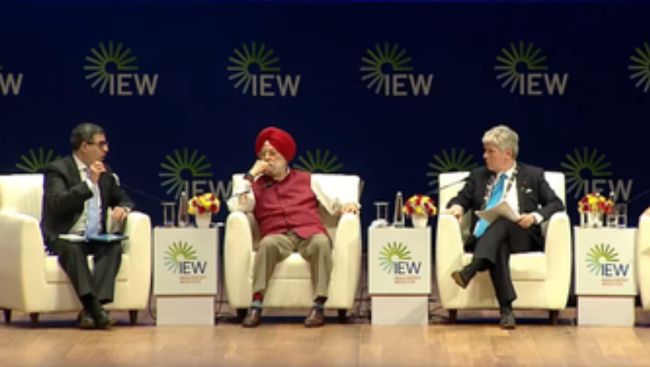
India and Canada on Tuesday signed a joint statement to strengthen cooperation in the energy sector during the India Energy Week 2026 held in Goa.  

The agreement marks a renewed push to deepen bilateral ties in areas such as oil, gas, clean energy and long-term investments.

The joint statement followed a bilateral meeting between India’s Minister of Petroleum and Natural Gas, Hardeep Singh Puri, and Canada’s Minister of Energy and Natural Resources, Timothy Hodgson.

Hodgson’s participation at India Energy Week 2026 was significant as it marked the first time a Canadian Minister attended the event.

During the meeting, both ministers formally launched the renewed India-Canada Ministerial Energy Dialogue.

They stressed that energy security and diversified supply chains are critical for the economic growth, safety and overall well-being of both countries.

The meeting was held in line with the direction given by the Prime Ministers of India and Canada during their interaction on the sidelines of the G7 Summit in June 2025 in Kananaskis, Canada.

At that time, both leaders had underlined the need to restart senior-level and working-level engagements between the two countries.

India and Canada acknowledged that their energy sectors complement each other well. Canada aims to become a global energy superpower in both clean and conventional energy, with a strong focus on expanding exports.

India, on the other hand, is emerging as a central player in the global energy market due to its large and growing demand.

Canada highlighted its expanding capabilities in liquefied natural gas, crude oil, and liquefied petroleum gas exports, especially to Asian markets.

India noted that it is the world’s third-largest oil consumer, fourth-largest LNG importer and third-largest LPG consumer, with one of the largest refining capacities globally.

India is also expected to account for more than one-third of the growth in global energy demand over the next two decades.

Both sides agreed to deepen bilateral energy trade. This includes the supply of Canadian LNG, LPG and crude oil to India, as well as the supply of refined petroleum products from India to Canada.

The ministers also expressed interest in encouraging stronger commercial and investment partnerships in each other’s energy sectors.

Canada shared that it is fast-tracking major energy and resource projects, supported by over $116 billion in investments announced in 2025.

India, meanwhile, highlighted policy reforms and investment opportunities worth around $500 billion across the entire energy value chain.

Picture Courtesy: IANS

MORE National ARTICLES

Interprovincial trade barriers: what they are, why they exist and how to cut them

Interprovincial trade barriers: what they are, why they exist and how to cut them
The Trump administration's on-again, off-again threat to impose damaging tariffs has boosted an old idea for driving economic growth in Canada: eliminating interprovincial trade barriers. Here's a look at how interprovincial trade barriers work and why years of efforts to tear them down them have largely failed.

Interprovincial trade barriers: what they are, why they exist and how to cut them

Trudeau says U.S. tariffs on Canada will be paused for 30 days

Trudeau says U.S. tariffs on Canada will be paused for 30 days
Prime Minister Justin Trudeau says "proposed tariffs" between Canada and the United States will be paused for at least 30 days while the countries work together on the border.

Trudeau says U.S. tariffs on Canada will be paused for 30 days

Canada's forestry sector faces uncertainty with 25 per cent U.S. tariffs

Canada's forestry sector faces uncertainty with 25 per cent U.S. tariffs
A wide shadow of uncertainty has been cast over Canada's forestry sector by U.S. President Donald Trump's decision to impose a 25-per-cent tariff on its lumber products. Several industry groups have released statements criticizing the tariff as unnecessary and harmful for both sides, a sentiment echoed by British Columbia Premier David Eby who vows full support for the provincial sector.

Canada's forestry sector faces uncertainty with 25 per cent U.S. tariffs

Trump mistaken, U.S. banks can and do operate in Canada says finance professor

Trump mistaken, U.S. banks can and do operate in Canada says finance professor
A finance professor at the University of Toronto says American banks do operate in Canada despite assertions by U.S. President Donald Trump that they are not allowed to do business in the country. The Office of the Superintendent of Financial Institutions lists Amex Bank of Canada, Citibank Canada and J.P. Morgan Bank Canada on Schedule II, all having U.S. parent companies. 

Trump mistaken, U.S. banks can and do operate in Canada says finance professor

B.C. critical minerals being diverted away from United States: David Eby

B.C. critical minerals being diverted away from United States: David Eby
Companies in British Columbia are in the process of redirecting critical minerals and energy products to markets outside the United States, Premier David Eby said, as the reality of U.S. President Donald Trump's tariffs sets in. Eby noted B.C. has opened new trade offices in Taiwan, Vietnam and the Philippines over the last 18 months.

B.C. critical minerals being diverted away from United States: David Eby

Winter's first widespread snowfall hits Metro Vancouver, with more on the way

Winter's first widespread snowfall hits Metro Vancouver, with more on the way
The first widespread snowfall of winter has hit Metro Vancouver, with Environment Canada warning the ongoing wintry blast could eventually bring up to 25 centimetres to start off a frigid week. The weather agency says in a snowfall warning for the region that "intense flurries" could bring heavy accumulation and cut visibility on roads.

Winter's first widespread snowfall hits Metro Vancouver, with more on the way