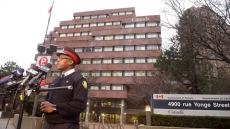
OTTAWA — When it comes to questions about who should be helping aboriginal communities navigate the Canada-U.S. border, the Liberal government's Public Safety and Indigenous Affairs departments are pointing the finger at each other.
Earlier this week, the Senate committee on Aboriginal Peoples issued a report urging the federal government to examine the challenges faced by First Nations communities that straddle the border.
The report, entitled "Border Crossing Issues and the Jay Treaty," details some of the logistical hurdles faced by residents of the Akwesasne reserve, which extends from Ontario and Quebec into the U.S.
It specifically urges Indigenous Affairs Minister Carolyn Bennett to appoint a "special representative" to come up with ways to make crossing the border easier for First Nations people.
"Although our minister is mentioned in the report, this is 100 per cent a Public Safety file," said an email from the department.
Public Safety, however, had a different perspective.
"We are reviewing the report and its recommendations," the department said in an email.
"While it is up to the minister of indigenous and northern affairs to respond to this recommendation, we are committed to collaborating with other government departments to address shared challenges and to serve the needs of Canadians."

The report focuses in particular on the logistical hurdles faced by residents of the Akwesasne reserve, which extends from Ontario and Quebec into the U.S. Parts of the Canadian side can only be accessed via the U.S., frustrating residents with families or jobs on the opposite side of the border, it says.
Assembly of First Nations Quebec regional chief Ghislain Picard agreed the issue needs to be addressed.
"A situation where people have to travel from Canada and across the border to the States and back to Canada just to get access to a medical centre or a clinic is totally ridiculous," he said.
"For the past few years, crossing the border has been more complicated…(now) there is (U.S.) Homeland Security involved. It was complicated before; it's even more complicated now."
The Jay Treaty, signed in 1794 by Great Britain and the United States, was established to resolve issues arising from the independence of the U.S. in 1776 and was meant to allow aboriginal people to freely cross the newly created border.
It has no practical application in Canada and has never been implemented, but served as guidance for the senators in preparing their report.

According to the Canada Border Services Agency, First Nations members are subject to the same requirements as all other individuals when entering Canada. The requirements are different, however, when they enter the U.S.
Those who are Canadian citizens and have a valid Certificate of Indian Status card can move freely with little hassle across the border. To work in the U.S. as a Canadian-born First Nation member, an individual must be able to prove they have at least 50 per cent aboriginal heritage.
The committee's report said the federal government has offered little help, and that the Canada Border Services Agency is in any event not in a position to provide a solution.