Indigenous bands along the west coast of British Columbia say their borders will remain closed to tourists and non-residents, despite the economic impact, as they work to raise awareness about the threat COVID-19 poses to their communities.
The Nuu-chah-nulth, the Heiltsuk Nation and the Haida Nation have all closed or restricted access to their territories and reserves.
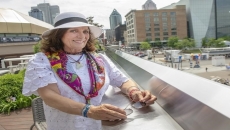
"Of course it's negatively impacting. But our directors have said, our chiefs have said, people before economics," said Judith Sayers, the president of the Nuu-chah-nulth Tribal Council, in an interview. "I think everyone is slowly realizing the impact economically, but right now we just really feel that we want to protect the members first."
Members of the Nuu-chah-nulth Tribal Council, made up of 14 First Nations along the west coast of Vancouver Island, have deployed a variety of tactics to help ensure their borders are kept sealed from non-residents.
Members of the Ahousaht First Nation, who live in the remote area of Flores Island, have deputized citizens to act as peacekeeping officers, Sayers said.
The Ahousaht issued a notice on July 2 that their territory, which covers a large area of land and water north of Tofino, including provincial parks, will remain closed to tourists and non-residents as there "is still no vaccine, no anti-serum and no cure for COVID-19."
Others, like the Tla-o-qui-aht in Tofino, had been stopping cars in an effort to convince them to turn around.
While Tofino is now welcoming back visitors, the Tla-o-qui-aht communities of Ty-Histanis, Esowista and Opitsaht remain closed to those who haven't been invited. The closure includes part of Long Beach in Pacific Rim National Park.
The concern, Sayers says, lies in the ability to test and contain any potential COVID-19 outbreak.
"A lot of our communities are remote and testing is not easily available," she said. "If you're in Port Alberni, or Nanaimo, or Victoria, or somewhere (else), you can get testing and get results in 24 hours. It's not the same with our communities."
The closures have resulted in disputes between Indigenous groups and local businesses.
The Haida Nation in Haida Gwaii have turned away non-residents at the ferry terminal, discouraged leisure travel and called on two local fishing lodges to rethink their reopening plans.
"We're such a close-knit community, I think that once we get a case of COVID, I think that it'll spread like wildfire," said Duffy Edgars, the chief councillor of the Old Massett Village council in Haida Gwaii.
Edgars said many local fishing lodges are respecting the Haida Nation's state of emergency, but is frustrated by others who want to open up.
"It's disrespectful," he said. "These bigger (lodges) are coming in and just doing whatever they want."
The fishing lodges that have opened say visitors and staff will not have contact with the Haida Gwaii communities, and they have emergence evacuation plans in place if a COVID-19 case were to develop.
Leaders and representatives from the Nuu-chah-nulth, Heiltsuk and Haida all say they would like to see more co-operation from the provincial government in working with Indigenous communities.
"It's really frustrating," said Marilyn Slett, the chief councillor of the Heiltsuk. "We have a limited amount of time here, we think, before that anticipated second or third wave so right now is the time for us to be sitting down and having those discussions so going forward we're all working collaboratively together."
Part of the issue, she says, lies in B.C. politicians encouraging residents to take part in inter-provincial tourism.
"We're seeing a lot more vessel traffic on the coast, we're seeing a lot more recreational boaters, and that's a really high concern for our community," said Slett.
The closures — many of which began in March — have been felt at a variety of levels.
The pandemic forced the cancellation of the Heiltsuk's Spawn-on-Kelp fishery this year, an event Slett says employs 700 people and is a hugely important economic driver for the community.
"Certainly our community put forward the health and safety before the economic driver," she said. "So our community has been hit hard."
Sayers says when the pandemic first broke out and restrictions were placed on communities, First Nations were bringing in food for members so they didn't have to leave their reserves and face possible exposure at grocery stores.
The Heiltsuk, Nuu-chah-Nulth and the Tsilhqot'in issued a statement in late June, criticizing the provincial government's reopening plan and what they saw as a lack of dialogue with First Nations groups.
All three want the province to commit to four conditions, which would allow border restrictions being lifted: COVID-19 information sharing, screening, rapid testing and culturally safe contact tracing teams.
Until those are met, Slett says, she can't see Indigenous communities fully opening their borders.
But the provincial government says it is committed to working with Indigenous communities.
"Many tourist-depending communities are now safely welcoming the gradual return of out-of-town visitors," said Sarah Plank, a spokeswoman for the Ministry of Indigenous Relations and Reconciliation. "At the same time, we acknowledge some smaller and more remote communities and First Nations continue to be concerned about visitors to their communities."
The government is also working on scheduling a meeting with the Nuu-chah-nulth, Tsilquot'in, Heiltsuk and Haida Nations and other communities, she added.