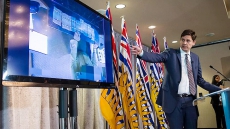
Legislation introduced Oct. 24, 2019, creates a path forward to recognize and uphold the human rights of Indigenous peoples in B.C.
“Today’s legislation is a crucial step towards true and lasting reconciliation,” said Premier John Horgan.
“With this new law, Indigenous peoples will be part of the decisions that affect them, their families and their territories.
Together with Indigenous peoples, we’re going to build a better future with good jobs and opportunities for people, strong environmental protections and healthy communities that include everyone.”
If passed, the Declaration on the Rights of Indigenous Peoples Act will make British Columbia the first province to bring the internationally recognized standards of the United Nations Declaration on the Rights of Indigenous Peoples (UN Declaration) into provincial law.
“B.C. has made significant progress on reconciliation together with Indigenous peoples already, and we’ll continue to work together to build an even stronger, more inclusive and more just B.C. that will create a better future for everyone,” said Scott Fraser, Minister of Indigenous Relations and Reconciliation.
“The legislation will create a path forward that upholds the human rights of Indigenous peoples, while creating more transparency and predictability in the work we do together. This is about ending discrimination and conflict in our province, and instead ensuring more economic justice and fairness.”
Developed in collaboration with the First Nations Leadership Council at the direction of First Nations, this legislation creates a framework for reconciliation in B.C., in keeping with the Calls to Action of the Truth and Reconciliation Commission.
“First Nations across B.C., Canada and the world are watching the introduction of this historic legislation. We are showing how the maturity and wisdom of our current leadership in this province, both Indigenous and non-Indigenous, can be a beacon for hope during these uncertain times,” said Regional Chief Terry Teegee, BC Assembly of First Nations. “I applaud Premier Horgan and his cabinet for their bravery and perseverance in moving this forward.
Implementing the UN Declaration is a non-partisan move, and we have been waiting 12 long years for this. Businesses and investors will benefit from this as it creates certainty and predictability for projects in this province – British Columbians will benefit from job creation and First Nations will benefit by having a seat at the table. Mussi Cho to all British Columbians. We are finally moving forward together.”
Cheryl Casimer, First Nations Summit political executive, said, “The provincial government has a long history of denying the very existence and rights of Indigenous peoples.
We are pleased that this changes today, and the Province of British Columbia is working with us in turning the page in our collective history and embarking on a new era and path for building a respectful and modern government-to-government relationship – a relationship built on recognition, respect, co-operation and partnership with a goal to improve the lives of our citizens and bring reconciliation to the forefront of society.”
Grand Chief Stewart Phillip, Union of BC Indian Chiefs, said, “Today is a good day. Without a doubt, this unifying bill represents an incredible step forward in Crown-Indigenous relations in the Province of British Columbia.
We are incredibly proud of how far we’ve come together, and we eagerly anticipate next steps. This landmark bill is not only aspirational but includes tangible and practical tools for implementation. We hold up our hands to our ancestors and past leaders for paving the way for this critical work, and we look to our grandchildren, who will enjoy a more certain future.”
Over time as laws are modified or built, they will be aligned with the UN Declaration. Additional elements of the bill include:
a requirement to develop an action plan to meet the objectives of the UN Declaration, in collaboration with Indigenous peoples;
annual public reporting to monitor progress;
discretion for new decision-making agreements between the Province and Indigenous governments where decisions directly affect Indigenous peoples and mechanisms exist in applicable legislation – with clear processes, administrative fairness and transparency;
and recognition for additional forms of Indigenous governments in agreement-making, such as multiple Nations working together as a collective, or hereditary governments – as determined and recognized by the citizens of the Nation.
To support self-determination and self-government, the act will enable the Province to recognize other forms of Indigenous governments in addition to federal Indian Act bands, treaty Nations and incorporated bodies and societies. This also provides more clarity for businesses and communities about who to engage when working with Indigenous partners.
In 2017, every cabinet minister in the provincial government was tasked with a mandate to implement the UN Declaration and the Truth and Reconciliation Commission’s Calls to Action. A commitment to adopting the UN Declaration in B.C. is a component of the Confidence and Supply Agreement with the BC Green Party caucus.
Quick Facts:
The First Nations Leadership Council is comprised of leadership from the BC Assembly of First Nations, First Nations Summit and Union of BC Indian Chiefs.
The Truth and Reconciliation Commission called on all governments in Canada to fully adopt and implement the UN Declaration as a framework for reconciliation.
The UN Declaration is a universal human rights instrument that includes 46 articles outlining the minimum standards for the survival, dignity and well-being of Indigenous peoples throughout the world. It has the support of 148 countries.
Actions taken since 2017 in B.C. to implement the UN Declaration include:
sharing $100 million annually in stable, long-term new revenues to support self-government and services that make life better for families in First Nations communities;
committing $550 million over 10 years to support the construction of 1,750 affordable housing units for Indigenous peoples on- and off-reserve;
dedicating $50 million to revitalize Indigenous languages;
modernizing the environmental assessment process;
amending child welfare laws to help keep Indigenous children with their families and communities;
implementing a new K-12 curriculum that integrates Indigenous culture and history; and
modernizing the treaty process to recognize the inherent rights of Indigenous peoples and align with the UN Declaration.