The federal budget fails to offer the investments in health and education their communities desperately need, some Indigenous leaders said Wednesday, a day after the Liberals tabled the latest fiscal plan in the House of Commons.
The budget froze annual base funding for Indigenous health and social services and for treaty work. Ottawa says that freeze amounts to a two per cent cut at a time when most federal agencies face a 15 per cent cut.
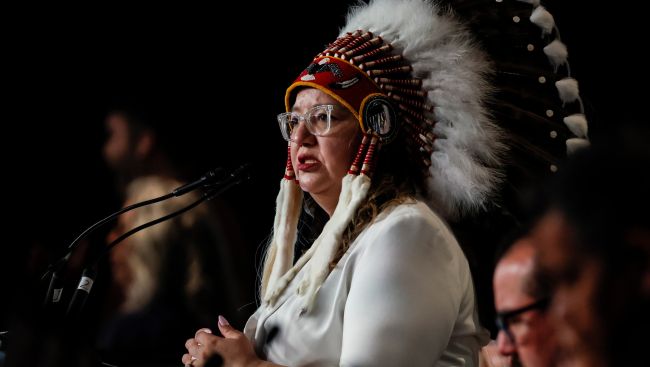
Assembly of First Nations National Chief Cindy Woodhouse Nepinak said the freeze will have serious impacts on communities with high birthrates. She also said the budget offers no plan to close the education gap that holds back economic growth in Indigenous communities.
"Sadly, yesterday's budget did not include any generational investments to close the First Nations education gaps that exist in this country," she told reporters Wednesday morning.
"Instead of closing the socioeconomic gaps between First Nations and non-Indigenous Canadians, this budget is going to make things worse."
Woodhouse Nepinak noted that more than half of the Truth and Reconciliation Commission's recommendations a decade ago related to education.
"This budget was a chance to build some of that trust. Sadly, it has failed, has failed to meet that moment," she said.
She said she was glad to see the government stick to its Indigenous housing commitments and praised the announcement of $2.3 billion over three years for water access on reserve and $10.1 million over three years for consultations on fast-tracked major projects. But she accused Ottawa of pursuing "trickle-down economics" that don't set up youth for success.
"The most effective way to secure the future success of First Nations children and our Canadian economy is to invest in education," she said, adding that chiefs have invited Prime Minister Mark Carney to address their national assembly next month.
Inuit Tapiriit Kanatami president Natan Obed praised the budget's promises of investments in the Arctic, and particularly its support for an Inuit university.
But he said Inuit are troubled that the document framed Arctic policy in terms of security and national sovereignty without explaining how the region's original inhabitants fit into that policy.
"We want to be partners with the Government of Canada, and all Canadians, in upholding Arctic sovereignty, in defending our borders, in working to do all that we can in this difficult time to make this country prosperous," he said.
"All we're asking on the other side is for a very clear consideration of the way in which we interact with the federal government."
He said the previous Trudeau government was better than the current one at working with Indigenous Peoples.
"It wasn't necessarily the absolute dollar and cents that was allocated to an initiative. It was also how rights-holding Indigenous peoples worked with the Government of Canada on implementing shared ambition and shared goals," he said.
He cited the fact that the budget mentions housing targets for the territory of Nunavut but not specifically for Inuit, many of whom live in other regions of Canada.
"Unfortunately, the lens in the budget is largely not considerate of Inuit communities and families in the way it describes territorial sovereignty," he said.
Obed said it was particularly troubling that the budget did not break down funding between the three major Indigenous groups in Canada: First Nations, Inuit and Métis. He said that will result in lengthy discussions with departments and possible legal battles over how much each group receives.
"It diverts specific implementation work to general lobbying and wrangling work, which is much more time-consuming," he said.
The organization also said it was "disturbed" that the budget did not renew funding to eliminate tuberculosis in the North, or set out for future years funding for Inuit children caught in jurisdictional squabbles between governments over services.
Métis National Council president Victoria Pruden also said she was disappointed the funding in the budget wasn't broken down by Indigenous group.
"It really falls short when it comes to identifying Métis-specific investments and dedicated distinctions-based funding, which is what we've really been used to in prior budgets," she said.
"The very mention of 'Métis' in that budget was less than we've seen in recent years. We cannot lose momentum."
Pruden said her organization has had some "encouraging conversations" with the government since the budget's release about how Métis people can fit into new employment, housing and export promotion programming. She also said she fears Métis will be disproportionately affected by federal funding cuts.
"We're holding a position of some good faith based on the early conversations that we've had, but we flagged for them we really need to know how we're going to be impacted," she said.
"We know that when the economy is facing uncertainty and a crunch and fiscally conservative policies, that our most vulnerable are at risk of increased houselessness, experiences of poverty (and) unemployment."
The Manitoba Métis Federation praised the budget for sticking with past housing and child welfare pledges.
Picture Courtesy: THE CANADIAN PRESS/John Woods