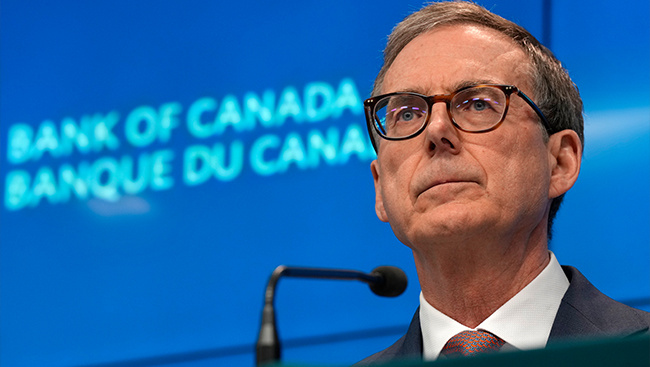
The unpredictability of the United States' trade war and signs of creeping inflation kept the Bank of Canada's interest rate on hold for a second consecutive decision on Wednesday — even as the central bank braces for an economic hit.
Bank of Canada governor Tiff Macklem said there was a "clear consensus" among monetary policymakers to leave the policy rate unchanged at 2.75 per cent as they wait for more information on the economic impact of tariffs.
“Uncertainty remains high,” Macklem said.
New U.S. duties of 50 per cent on steel and aluminum imports — double the previous rate — that took effect Wednesday "underline the unpredictability of U.S. trade policy," he said.
The Bank of Canada keeps its policy rate elevated when it wants to discourage spending to tamp down inflation and lowers the rate when it wants to stimulate the economy.
Global trade disruptions tied to the United States’ tariff campaign, and Canada’s retaliatory response, can have the effect of both raising prices and hampering growth.
"The uncertainty really is a double-edged sword for them," said BMO chief economist Doug Porter.
"It doesn't mean that they should cut more or less. It just makes it more and more uncertain, and they almost have to take it on a meeting-by-meeting basis."
Macklem said there was a “diversity of views” about the direction of monetary policy going forward among the central bank’s governing council.
He said that, “on balance,” the council felt there was room for the Bank of Canada to lower its policy rate if there were signs the tariff dispute was starting to weaken the economy while price pressures remain contained.
But he also cautioned against taking that reference to policymakers' deliberations as guidance about what the central bank might do next.
“We will continue to support economic growth while ensuring inflation remains well controlled,” Macklem said.
He reiterated that the Bank of Canada would be “less forward-looking than usual” and more attuned to risks.
Macklem said the central bank is expecting a weaker second quarter after businesses rushed to get ahead of tariffs in the first few months of 2025. He also mentioned concerns for residents affected by wildfires raging in the Prairies but said it was too soon to offer estimates of the economic impact.
Porter said the Bank of Canada is probably risking a steeper economic downturn by holding its policy rate steady at two consecutive decisions, but he said it's a risk the central bank likely has to take.
The Bank of Canada's closely watched metrics of core inflation accelerated above three per cent in April amid what Macklem called "unusual volatility" in the underlying price pressures.
"That has gotten our attention," he said.
For the Bank of Canada to cut its policy rate when core inflation is above three per cent, the economy would have to be really weak, Porter said.
But the first-quarter real gross domestic product figures topped the central bank's expectations and labour market weakness is so far concentrated in trade-sensitive sectors. Consumer and business spending has been resilient even as confidence takes a hit.
“The door just wasn’t open there for a rate cut today," Porter said.
The Bank of Canada will get two months of inflation and jobs data before its next interest rate decision on July 30.
Financial markets placed odds of a July rate cut at roughly 44 per cent as of Wednesday afternoon, according to LSEG Data & Analytics.
Porter said the next decision is a "coin toss" given all the data that's yet to come, but he expects there will be enough clarity in the economy for the central bank to cut its rate by a quarter of a percentage point in July.
After that, a return to the wait-and-see pace — Porter sees the Bank of Canada's policy rate bottoming out at two per cent in early 2026.
CIBC chief economist Avery Shenfeld said in a note to clients Wednesday that he is expecting a quarter-point rate cut in July if the jobs market shows more cracks and inflation eases on non-tariffed items.
He said he sees another cut in September, bringing the policy rate down to 2.25 per cent.
TD senior economist Leslie Preston also sees lower rates ahead.
"We expect that barring a trade negotiation miracle with the Trump administration, Canada's economy is likely to tip into recession this year, and more interest rate cuts will be required," she wrote in a research note.
The Bank of Canada will also publish a new monetary policy report at its July meeting. In the April report, the central bank did not publish a single economic forecast and instead laid out two illustrative "scenarios" for the tariff impact amid the considerable uncertainty.
Senior deputy governor Carolyn Rogers said Wednesday she hopes the Bank of Canada will have enough clarity to return to a central forecast in July.
The federal government is also seeking a path through the trade uncertainty with the United States. Ottawa has announced plans to table its annual budget in the fall, rather than in the spring as it typically would.
Porter said that delay is likely also contributing to the Bank of Canada's hesitance to move quickly with its interest rates. If fiscal policy will end up delivering substantial stimulus through deeper deficits, that limits how low the central bank would have to take its policy rate, he said.
Macklem said the Bank of Canada is still making note of how government spending decisions will affect inflation and growth projections, but pushed back against a question about whether the lack of a spring budget was further clouding the outlook.
“To be frank, the budget is not the biggest source of uncertainty facing the economy – it’s U.S. tariffs," he said.
Picture Courtesy: THE CANADIAN PRESS/Adrian Wyld