Influencers had the "loudest voices" online in this spring’s federal election, overtaking news outlets and politicians, says a new report.
The report from the Canadian Digital Media Research Network, co-ordinated by the McGill University and University of Toronto-led Media Ecosystem Observatory, looked at the election information environment.
Influencers were the most active in terms of frequency and volume of online posts and received the most engagement, said Aengus Bridgman, director of the Media Ecosystem Observatory.
"This is new to this election … materially different," he told The Canadian Press.
Previously, media organizations and politicians got a very large amount of online engagement and were able to anchor the conversation though frequent posts and news stories that would receive a lot of attention online, Bridgman said.
"That is simply not true anymore."
Influencers accounted for almost half — 47 per cent — of the political content in the researchers’ data set, while news outlets made up 28 per cent and politicians accounted for 18 per cent, the report says.
"Influencers, not parties or newsrooms, dominated distribution and attention across platforms during the campaign," it concludes.
That shift is "consistent with the news-sharing ban on Meta and reduced visibility of news on X, which elevated non-news voices and ‘infotainment’ publishers," the report adds.
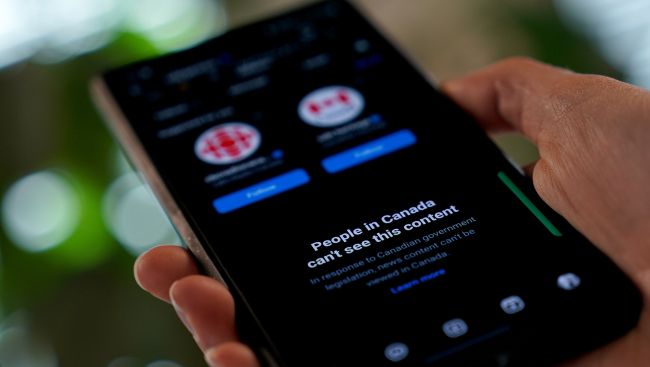
Meta blocked news from its Facebook and Instagram platforms for Canadian users in 2023, in response to the federal government’s Online News Act.
The report says that news ban "created an information void that has, in part, been filled by less trustworthy content."
It also points to the takeover of Twitter, now named X, by billionaire Elon Musk, a former ally of U.S. President Donald Trump.
The report says Musk’s "political stances and recent changes made to the platform have also contributed to greater fragmentation of the online information environment, as some centrist and left-leaning users migrated to alternative platforms such as Bluesky."
The researchers tracked about 4,000 Canadian entities between Feb. 23 and May 28, including politicians, media organizations, government bodies, civil society organizations and "prominent online personalities."
It captured 1.52 million posts across X, Instagram, TikTok, Bluesky, YouTube and Telegram.
Bridgman said Canadians seem to have a "preference" for influencer content now.
"It doesn't seem to be delivering facts or policies," he said. "It seems to be reactions to events, interpretation, commentary … That seems to be what people are craving now."
Bridgman said the line between influencers and traditional media can be blurry, especially in Canada, where many political influencers have a footprint in traditional media.
The researchers behind the report defined "influencers" during the election as individuals with at least 10,000 followers whose content was two-thirds politics — mostly Canadian politics — and who didn't use their online presence purely in a professional capacity.
That means a journalist couldn’t be classified as an influencer if they used their online presence merely to talk about their journalistic work, Bridgman said — they had to go beyond that by, for example, offering broader commentary.
"Influencers are entities that primarily exist and operate in online spaces and, through commentary, political reactions, engagement with other entities, come to really shape the conversation," he said, adding influencers "are large enough on the platform that they actually have a voice and get some uptick."
The report calls on influencers to embrace their democratic responsibility by "demonstrating how to critically evaluate information," verifying that information, disclosing sponsored content and providing credible information on voting and democratic participation.
The rise of influencers was only one element examined by the report. Researchers also looked at foreign interference, misinformation and changing demographics on major online platforms.
The report says it found "an information environment shaped by influencers, digital manipulation and disruption, political polarization, and weakened platform governance and accountability."
While the report says those factors didn’t alter the outcome of the election, it warns that without reform, "Canada is likely to enter future elections less prepared, more divided, and more exposed to manipulation."
The report called for online platforms to be more transparent.
Bridgman said researchers "don’t have the data access and visibility to properly communicate to Canadians that manipulation has or has not occurred."
He called the situation "untenable."
Picture Courtesy: THE CANADIAN PRESS/Giordano Ciampini