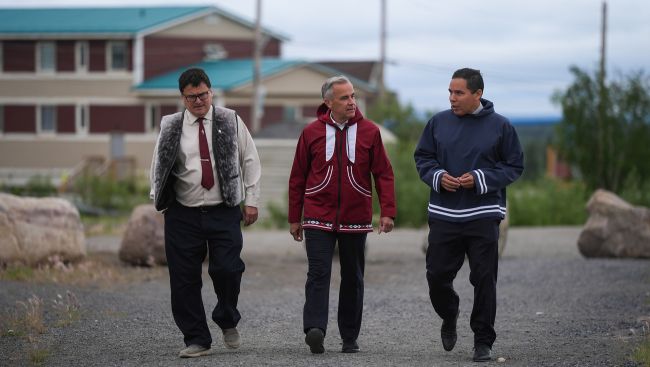
Inuit Tapiriit Kanatami president Natan Obed compares working with Prime Minister Mark Carney's government to being a contestant on the TV show "Dragons' Den."
Under Justin Trudeau's government, he said, Inuit communities could come to Ottawa with policy proposals and expect engagement and a decision.
Under Carney, he said, they're expected to do their own analysis in advance and make a pitch for federal investment based on the likelihood of economic benefits.
"The lens of any of our social policy is … now being run through this idea of whether or not there are returns to the Canadian state and if there's profitability for a dollar invested by the Government of Canada," Obed said.
"These types of questions are being asked of us no matter where we go, and it's almost as if the federal government has decided that it doesn't have to do that itself anymore, even though it is the one that is deciding these social policy considerations."
Inuit leaders and communities were braced for a change in their relationship with the government in the months ahead of last year's federal election. Conservative Leader Pierre Poilievre was poised to lead his party to a landslide victory at the time, and some Inuit worried about funding cuts and the reconciliation project being pushed to the back burner.
But when Carney took the helm and continued using the reconciliation language of his predecessor, Obed said, leaders were left unprepared for changes in personal relationships they'd built up with key ministries — and for the federal government's sudden decision to make Arctic defence a priority.
"It's been hard to try to figure out where we fit when the partnership seemingly hasn't changed on the surface, but structurally many pieces that were essential to the maintaining of the relationship were swapped," he said.
Inuit have a unique relationship with the federal government. Their territories span the Arctic, a geopolitically vital and vulnerable region covering about 40 per cent of Canada's land mass and even more of its coastline.
But while Carney, the premiers and territorial leaders have spoken often about Arctic sovereignty — and the threat Russia in particular poses in the region — Inuit have been largely left out of those conversations, Obed said.
Meanwhile, he said, Inuit communities are seeing little or no progress on social policy goals set by the Trudeau government, such as the elimination of tuberculosis in the territories by 2030 and ensuring Inuit children have equal access to health care and other social services.
Indigenous Services Minister Mandy Gull-Masty said the federal government's goal is to "build capacity" in Indigenous communities.
"I'm a very strong proponent of accountability and transparency and making sure that the dollar we use to offer services has an impact that we know and understand," Gull-Masty told The Canadian Press.
"I think that putting in the work to know and explain what the future is that you're trying to build for your members is only going to make sure that we are in a better position to support Indigenous communities."
But Ottawa itself has been known to get in the way of its own goals for Indigenous policy. The federal auditor general reported last year that application-based programs under Indigenous Services Canada are harder for Indigenous communities to access because the department has failed to build up local administrative supports.
Crown-Indigenous Relations Minister Rebecca Alty pushed back against the claim that the federal government is allowing economic considerations to override all others in its relationship with Indigenous communities.
"We are still focused on the whole suite … It's not just major projects. We need whole communities, whether that social programs, whether that's the infrastructure, housing, water, recreation facilities," she said in an interview with The Canadian Press.
Obed said he's particularly concerned about the fate of funding for the Inuit Child First Initiative, set to expire at the end of March. The program is meant to ensure Inuit children have equal access to health, social and educational services.
Obed said he fears Inuit kids will be left without that support before the Liberals table their spring economic statement.
Gull-Masty said she doesn't expect any disruptions to delivery but wouldn't say what the government has planned for the Inuit Child First Initiative.
"I'm eagerly awaiting to have further discussions with (ITK) and looking forward to what we're going to announce in the next step," she said.
U.S. President Donald Trump's trade war and threats against Canada's sovereignty have turned Canadian politics inside-out. After decades on the margins, Arctic policy and national defence are now top political priorities — and Inuit leaders like Obed are determined not to be left out of the debate.
He took part in a recent delegation to Greenland's capital Nuuk, where the federal government has opened a new consulate. Ottawa first pledged to launch the new diplomatic mission in December 2024, well before Trump started escalating his threats to annex the Danish territory.
Speaking ahead of that trip, Obed said Inuit in Greenland — who make up the majority of the population — have much more robust infrastructure and better access to social programs than Inuit in Canada.
If Canada wants to protect its place in the North, he said, it has to earn it — through long-overdue infrastructure investments and a whole new level of engagement with the people living on its Arctic frontier.
"The cheapest way to ensure territorial sovereignty is really through the investment in our communities," he said.
"A strategic country would utilize the strength of its relations with its Indigenous Peoples and would understand its own construction so as to meet the moment with the best possible political consideration and the strongest possible response."
Picture Courtesy: THE CANADIAN PRESS/Darryl Dyck