The Bank of Canada will be balancing a last-minute flood of economic data with uncertainty around trade and war in the Middle East as it prepares to make its second interest rate decision of 2026 this week.
Economists say the central bank faces choppy waters in setting monetary policy this year, as a surprise spike in unemployment and weakness elsewhere in the economy weigh against fresh inflation risks from a global oil price shock.
The Bank of Canada's policy rate stands at 2.25 per cent after a hold in January, but the economic landscape has shifted since that decision nearly two months ago.
Friday's jobs release showed the unemployment rate rose to 6.7 per cent after the economy lost 84,000 jobs in February.
Late last month, Statistics Canada also reported the economy contracted by half a percentage point on an annualized basis in the fourth quarter of 2025, undershooting the Bank of Canada's call for flat growth.
Monetary policymakers will also be contending with fresh inflation data from Statistics Canada on Monday.
BMO chief economist Doug Porter said February's inflation rate could go as low as 1.8 per cent — a half-point drop from January's figures — as the federal government's "tax holiday" from a year earlier, which skew the comparison, falls out of the annual inflation calculation mid-month.
Absent the latest price data, financial markets placed the odds of an interest rate hold on Wednesday around 92 per cent, according to LSEG Data & Analytics. Odds of a cut rose marginally after Friday's weak jobs data.
Many economic forecasts from the first two months of the year had the central bank remaining on the sidelines for the remainder of 2026 as core inflation settles and the economy continues to adjust to U.S. tariffs.
"Ultimately, what we're seeing was the economy was weak but not one where it necessarily warranted the Bank of Canada to move interest rates in either direction," said Desjardins deputy chief economist Randall Bartlett.
But that economic data is set for a bout of volatility tied to the war in the Middle East triggered by the United States' and Israel's strikes on Iran.
Iran's attacks on commercial ships in the Persian Gulf and its move to blockade the Strait of Hormuz — where a fifth of the world's oil transits — have sent the global price of oil skyrocketing in recent weeks.
That's driven up prices at the pumps in Canada and will likely push inflation figures higher in the coming months, Porter said.
He noted April's inflation reading will spike particularly high because of comparisons to the previous year — when the federal Liberals cancelled the consumer price on carbon, taking roughly 18 cents off a litre of gas at the time.
Beyond the pinch at the pumps, Porter said higher energy costs will likely feed into packaging and transportation costs for food. With the Gulf region also responsible for shipments of key inputs for fertilizer, the war could also compound pressures on farmers in the food supply chain.
StatCan reported food inflation stood at 7.3 per cent annually in January, spurred higher by the tax holiday comparisons as well as supply crunches on grocery staples like coffee and beef.
"We were already grappling with uncomfortably high food inflation and, unfortunately, I think this will aggravate it a little bit more," Porter said.
Volatility in the price of oil and uncertainty around the length of the conflict mean the net impact on Canada's economy is uncertain.
Both Porter and Bartlett said that oil-producing provinces such as Alberta, Saskatchewan and Newfoundland and Labrador are somewhat shielded from an associated downturn and could even see their gross domestic product rise on the back of higher energy prices. Other provinces, meanwhile, are facing a more dour outlook.
Bartlett said he sees national GDP getting a net lift in the wake of higher energy prices, which, alongside higher inflation, would tilt the Bank of Canada away from needing more stimulative rate cuts.
But he also said the looming review of the Canada-U.S.-Mexico agreement marks another substantial piece of uncertainty keeping the central bank from shifting its policy rate in one direction or another.
Bartlett said he's calling for a rate hold at this week's decision and believes the bank will stay there for the rest of the year. He added that recent market pricing baking in a quarter-point rate hike before the end of the year is premature.
"Our sense is that the Bank of Canada is likely to look through the oil price shock that we're experiencing now, if it does turn out to be something that is temporary," Bartlett said.
Porter said that while Canada may be better shielded from the oil price shock than other countries, he still believes it will be net negative for the economy.
But even if the conflict takes some steam out of the economy, he said a rate hike is still in the cards. He cited a speech from Bank of Canada deputy governor Sharon Kozicki in Norway last month where she explained that the central bank is more likely to raise rates when a supply shock increases prices but doesn't sharply slow the economy.
"I would say higher oil prices is a supply side shock," Porter said. "It slightly increases the chances that they might feel they have to raise rates later this year. I don't think that's the right thing to do, but that's the way the market is leaning."
Porter said he believes the Bank of Canada should still be biased toward lowering interest rates given headwinds from U.S. tariffs and trade uncertainty.
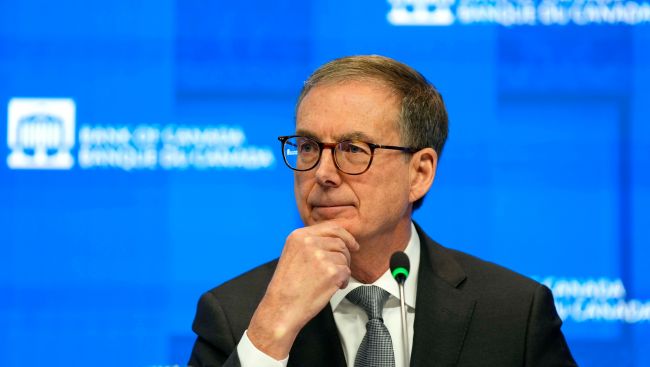
He said he'll be listening closely to how Governor Tiff Macklem speaks about the Middle East war after the interest rate announcement this week to gauge how much the conflict could weigh on future rate decisions.
"We have our own opinions on what the bank should do, but what really matters is what they will do, and their comments will help guide us on that front," Porter said.
Picture Courtesy: THE CANADIAN PRESS/Justin Tang