

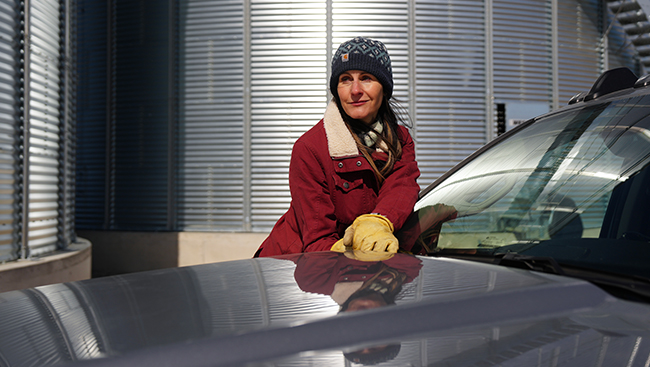
Canola runs deep on Margaret Rigetti’s farm in southern Saskatchewan.
Her grandfather was among the first to grow the bright yellow flowering crop in the 1970s, and it has been a staple ever since.
“For a large part of Saskatchewan, the farm economy has been driven by canola,” Rigetti, a director with SaskOilseeds, says in an interview on her land near Moose Jaw.
“It feels personal when people come after canola, just because it’s such a Canadian story, such a western Canadian story, such a Saskatchewan story and such a story that's right here on my farm."
China hit Canadian farmers with 100 per cent tariffs on canolaoil, canola meal and peas in retaliation to Canada slapping Beijing with levies on Chinese-made electric vehicles, steel and aluminum.
Producers are also caught with uncertainty around U.S. President Donald Trump’s tariffs. Trump has imposed levies onCanadian aluminum, steel and automobiles, while musing about applying additional duties.
Products that fall within the Canada-U.S.-Mexico agreement, including agricultural and energy goods, are not subject to U.S. tariffs. Canada has retaliated with countermeasures.
Rigetti has the TV news on in her living room. She says she’s been watching it more often to keep up with the latest developments.
“We’ve seen challenges before, but we’ve never been in the crosshairs between our two biggest trading partners," she says.
She pulls out a book of her family history, flipping to a page with an image of a combine picking up canola swaths. Underneath, an excerpt reads, "The new crop that changes everything."
Canola is a portmanteau word combining Canada and ola, which means oil. Saskatchewan and Manitoba researchers developed the crop in the 1970s to address erucic acid issues in its predecessor, rapeseed.
Canola is used for cooking oil, high-protein animal feed andbiodiesel. The crop's development led to the boon it is today for farmers’ pocketbooks, with more than half of it grown in Saskatchewan.
In Rigetti's yard, there are massive steel bins where her husband and son empty dark brown canola seeds into a truck. They're off to deliver the product to a grain terminal.
Rigetti says her son will plant his first field of canola this year.
“We have to be careful to keep things in perspective and not scare our kids," she says.
"I do try to keep the focus on what we can actually control, which is planting a crop, growing the best crop we can grow, manage our costs and manage our mental health."
At a farm near Fillmore, southeast of Regina, producer Chris Procyk says history is repeating itself.
“We are unfortunately once again caught in the middle of a trade dispute that we didn’t cause or we didn’t create, andwe’re left paying the bill,” says Procyk, vice-president of the Agricultural Producers Association of Saskatchewan.
He also says there would be greater problems if the U.S. imposes levies on agricultural goods. Canadian crops andpotash go south and farm machinery comes up north.
Procyk says the federal government should provide financial aid or other supports to farmers who have been affected by the trade war.
“There’s not really a place to pivot,” he says. “The whole farm is under a trade dispute, and we don’t have control of how these things play out.”
Farms have faced headwinds from China before.
In 2019, Beijing blocked Canadian canola imports from two companies, citing contamination issues, though the move was believed to be in response to Canada detaining Meng Wanzhou, a Chinese business executive. Canadians Michael Spavor and Michael Kovrig were also detained in China days after Wanzhou's arrest.
Wanzhou and the two Canadians were released to their countries in 2021. China lifted its ban on canola the next year, but it's estimated the Canadian economy lost about $2 billion as a result of the dispute.
“Farms can withstand some short-term pain," Rigetti says. "If it goes on longer, it calls things into question."
Picture Courtesy: THE CANADIAN PRESS/Chris Young


