OTTAWA - The United States and Canada aim to tweak their security relationship, but U.S. Secretary of State John Kerry says that's not a sign of any shortcoming that emerged from last week's fatal attacks on Canadian soldiers.
The top U.S. diplomat came to Ottawa for the day to show American solidarity with their Canadian friends and top ally.
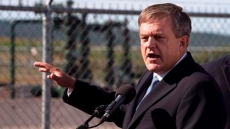
He delivered that message with a mix of elan and gravitas, at a joint press conference in the foyer of Foreign Affairs headquarters, opening his remarks in flawless French by thanking his "cher ami," Foreign Affairs Minister John Baird.
Kerry said Canada and the U.S. would "work quietly and carefully in the next days and months" to strengthen an already close security relationship.
"Canada and the United States are now in discussions — not with any sense that things weren't done, or that there is some information that we didn't somehow share or have — but rather with a view to making certain that every possible stone is turned over, every possible policy is reviewed because our obligation, obviously, is to protect our citizens," Kerry explained.
Kerry's upbeat remarks appeared aimed partly at assuaging any possible American jitters in the aftermath of last week's attacks that left two Canadian Forces soldiers dead in Ottawa, after an attack on the War Memorial and Parliament, and in Quebec.
Canadian officials have already mounted a diplomatic blitz in the U.S. to emphasize Canada's commitment to border security.
On Tuesday, Kerry said both countries would continue to intensify law enforcement co-operation, border protection and intelligence sharing.
"I'm confident we'll come up with some tweaks, some changes, some additions that will promote even greater security than we have today."
Kerry also said "common sense" dictates that last week's attack in Ottawa was an act of terror, but that it will ultimately be for Canadian law enforcement to make a final determination.
Kerry said he didn't want to prejudice the ongoing Canadian police investigation, but he said the nature of the events speaks for itself.
"Clearly anybody who walks up in a premeditated way with a rifle and attacks somebody in uniform and then purposefully goes to a parliament is committing, by common sense standards, a terrorist act."
Baird echoed that "common sense" characterization, reiterating the view that the Conservative government has taken on the attack since last Wednesday when Prime Minister Stephen Harper linked the Ottawa shooting to terrorism.
Kerry also recalled how in the aftermath of the Boston Marathon attack last year, his hometown emerged united and resolved, rallying behind the slogan, "Boston Strong."
"This week with an equal measure of sadness mixed with resolve," Kerry said, "the echoes can be heard here in Canada: Ottawa Strong, Quebec Strong, Canada Strong."
Earlier, joined by Baird, Kerry placed a wreath at the National War Memorial.
The two then sat down to discuss the threat posed by Islamic State of Iraq and the Levant (ISIL), the situation in Ukraine, border management and North American energy co-operation.
Baird raised the Keystone XL pipeline project, which Kerry's department is reviewing. Repeated delays in approving the line have caused friction between Canada and the U.S. But Kerry had nothing new to say on the status of the project.
Canadian officials quietly hope Congress may force Kerry and the White House to approve the project.
Kerry was to end his whirlwind day in Ottawa with a late afternoon meeting with Harper in his Centre Block office on Parliament Hill, not far from where the armed man who shot Cpl. Nathan Cirillo was killed in a gunfight with security.
Baird is to take Kerry on a private tour of Centre Block, the scene of the shootout with attacker Michael Zehaf Bibeau last week, before they meet Harper.