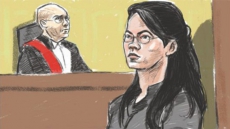
TORONTO — The jury hearing the trial of a man accused in a deadly shooting at Toronto's Eaton Centre mall must decide if the mental disorder he was suffering was severe enough to render him incapable of appreciating his actions, a judge instructed Tuesday.
Superior Court Justice Eugene Ewaschuk told jurors they have three verdicts available to them — guilty, not guilty or not criminally responsible.
Christopher Husbands has admitted to fatally shooting Nixon Nirmalendran and Ahmed Hassan and wounding five others in June 2012, but has pleaded not guilty to multiple charges that include two counts of first-degree murder.
His defence lawyers have argued Husbands should be found not criminally responsible by reason of a mental disorder.
A psychiatrist called by the defence testified that Husbands suffered from post traumatic stress disorder and acted like a "robotic automaton" when he found himself confronted at the mall by two men who had viciously attacked him months earlier.
The Crown, however, has argued that Husbands gunned down the two men in deliberate retaliation for a previous attack on him.
In explaining the defence of not criminally responsible for jurors during the trial, Ewaschuk said the burden is on the accused in the case to prove insanity.
"If you find that he was acting in a state of mentally disordered automatism at that time, your verdict should be not criminally responsible for all counts. That would be the end of your deliberations," Ewaschuk told the jury.
If the jury rejects the defence of mentally disordered automatism, they must consider if Husbands is guilty of second-degree murder, manslaughter, or first-degree murder, Ewaschuk said.
Jurors must weigh all the evidence before them, he said, including video surveillance footage from the crowded food court at the Eaton Centre, where Husbands opened fire.
"The silent video tapes are the best witness in this case ... they have a perfect frozen memory," Ewaschuk said.
The jury needs to consider, among other things, "truth versus fiction, reality versus fabrication" and "videotaped accuracy versus accused's credibility," Ewaschuk said.
"It is for you to determine whether Christopher Husbands experienced true disassociation."
The Crown has conceded that Husbands developed PTSD as a result of being beaten and stabbed 22 times in February 2012, but has argued the disorder was "far from disabling, Ewaschuk told the jury.
Crown prosecutors have also argued that Husbands' own description of his PTSD was "greatly overdone," Ewaschuk noted.
Meanwhile, Husbands's lawyers have argued that following the vicious February attack, Husbands changed, growing anxious and hyper vigilant.
They have suggested that the sight of his assailants at the Eaton Centre on that day in June triggered an emotional reaction in Husbands, particularly after he said he heard one of them say "shoot him" and saw another man move his hand towards a pocket.
In recapping the defence's key argument, Ewaschuk said Husbands' lawyers have suggested that "during the shooting the accused had no operating mind. He was a robotic automaton."
Husbands has told his trial he "zoned out" during the shooting, seeing dark shadows as he fired 14 rounds and hearing nothing more than pins as panic erupted.
It is important, however, that jurors determine whether Husbands' statements about what he heard and saw at the food court was true, Ewaschuk said.
"Assuming that you find as fact that neither the statement was said nor the gesture heard, there is no evidential basis to find that he experienced a disassociative state," he said.