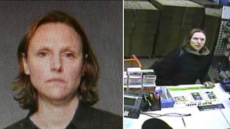
An Ontario court has upheld a judge's decision to acquit a woman of a drunk driving-related charge because police weighed her when taking breath samples at a station.
Marc Labrosse of the Ontario Superior Court of Justice dismissed the Crown's appeal of Kimberley McLachlan's acquittal in August 2015.
A lower-court judge ruled that asking McLachlan to step on a scale after an arrest for an alleged excessive blood alcohol level was a breach of her privacy and subjected her to unreasonable search and seizure.
The breach of McLachlan's rights meant that evidence obtained from a breath test had to be dismissed.
Court heard that McLachlan failed a roadside screening test after several attempts and later registered a blood alcohol level of nearly twice the legal limit when tested at a police station.
Labrosse said the demand for McLachlan's weight represented a serious breach.
"I acknowledge that the weighing of an individual is not as intrusive as the taking of bodily fluids. However, I am still of the view that the respondent had a reasonable expectation of privacy in her weight," Labrosse wrote in his March 3 decision.
"While the trial judge concluded that the breach was 'somewhat intrusive,' I would go further and state that in my view it had a significant impact on the charter-protected interests of the respondent."
The case began in January 2012 when Ottawa police observed McLachlan driving on a dead-end road.
After noting some erratic driving, police pulled her over and noted a strong smell of alcohol coming from the car, court heard. McLachlan tried to complete a roadside screening test five times before registering a "fail" on the sixth attempt, court heard.
She was then taken to a station where she ultimately registered blood alcohol readings of around 160 milligrams of alcohol per 100 millilitres of blood, twice the legal limit of 80 millilitres, court heard.
During that time, when administering a breath test at the station, an Ottawa police officer told McLachlan that it was standard practice to provide her weight, court heard.
Court heard that McLachlan was resistant to the idea, asking once if she had to do so, but ultimately complied.
McLachlan's weight became relevant in the case because breathalyzer tests were conducted more than two hours after she was pulled over.

Current laws state that if tests are not conducted within two hours of the time a person had control of a vehicle, then experts must be brought in to try and determine the level of impairment when they were still behind the wheel.
Court heard that a toxicologist needed McLachlan's weight in order to complete the assessment, but Canadian legislation does not currently indicate that police are allowed to ask someone to step on a scale or verbally provide their weight
The trial judge ruled that officers could have used other means to determine her weight, such as visually estimating it based on her size.
Labrosse agreed, saying just because asking someone to step on a scale was common practice among Ottawa police does not mean it was supported either by internal policy or Canadian law.
"The absence of a properly identified OPS policy which deals with the manner of obtaining or estimating the weight of a detainee represents a breach which cannot be qualified as inadvertent," he wrote.
"While I acknowledge that it does not amount to bad faith, the breach here demonstrates an ignorance of the scope of the police authority in such circumstances and such ignorance of the scope of authority is still misconduct from which the court should be concerned to dissociate itself. While it is not the most serious of breaches, I still find it to be at the more serious end of the spectrum."
The ruling comes shortly after another Ontario case related to alleged drunk driving was dismissed because police took 10 minutes between announcing their intention to conduct a roadside screening and actually administering the test.
The judge in that case ruled that police violated the law by not conducting the screening "forthwith," a legal term for "without delay."
Criminal defence lawyer Sean Robichaud said the two cases demonstrate the many complications around impaired driving legislation, saying police forces are now hearing a clear message to adhere strictly to the letter of the law.
"It's a common thread throughout impaired cases in general that there are very strict parameters in which police," he said. "And when police step outside of that legislation, they run the risk of evidence being inadmissible, which may be necessary to prove the case."