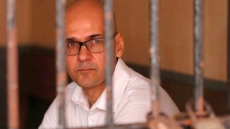
TORONTO — Two men accused of plotting to derail a passenger train need to have "genuinely meant" to bring about that alleged crime, as opposed to feigning that intention, a jury was told Wednesday as they entered their eighth day of deliberations.
The instructions were delivered by Justice Michael Code in response to a question from the 12-member panel weighing the fate of Raed Jaser and Chiheb Esseghaier.
The question — the jury's fourth since being sequestered — focused on the element of intention required to form a conspiracy.
"This is an incredibly important question and an incredibly important juncture of the trial," Code said. "We've got to get this right."
Jaser and Esseghaier are both charged with two counts of conspiracy, and two counts of participating in or contributing to a terrorist group. Esseghaier is also facing a fifth terror-related charge.
Code had instructed the jury last week that there are two essential elements to any conspiracy — an agreement to commit a crime and an intention to carry it out.
The jury asked for further instructions on whether it was "sufficient to find an intention to explore, research or initiate the train plot, or is it necessary to find beyond a reasonable doubt an intention to carry the train plot to fruition."
In a five-page response, Code told jurors the elements of agreement and intention in a conspiracy were intrinsically linked.
"The two elements must relate to one another and they must coincide at the same point in time," he said, adding that an agreement in the law of conspiracy means "a positive meeting of minds or true consensus between two persons."
"The element of intention means that the two parties to the agreement genuinely meant to bring about that crime as opposed to feigning that intention while having some other intention such as making money," Code said.
The jury's question appears critical to Jaser, whose lawyer argued that the 37-year-old was never actually intent on carrying out any terrorist activities, but was only feigning interest as part of an elaborate con to extract money from his co-accused and an undercover FBI agent who gained their trust.
Code emphasized that a conspiracy comes into existence when two people agree to commit a specific crime and "at that very moment of agreement they genuinely intend to put that agreement into effect."
A "mere intention to explore or research a 'train plot' idea" would not be sufficient to prove intention of a conspiracy, Code added, nor would just introducing the idea of such a plot and discussing it.
"Intentionally agreeing to cause a train derailment, or intentionally agreeing to pursue the common unlawful object of derailing a passenger train, that would be sufficient," he said. "Any subsequent change in intention does not negate a prior intention."
The trial heard hours of secretly recorded conversations between Jaser, Esseghaier and the undercover FBI agent in which they discussed plans to allegedly create a hole in a railway bridge outside Toronto to derail a passenger train and cause the deaths of scores of people.
Jaser eventually dropped out of the alleged plot while Esseghaier continued to pursue it.
Crown prosecutors have argued the two men made up an alleged terrorist group operating in Canada, and suggested the jury find both men guilty based on the "overwhelming'' evidence against them.
Esseghaier did not defend himself at his trial but did give the jury a written closing statement in which he offered his "sincere advice" to the panel, urging them to apply the Qur'an to every aspect of their life.
Jaser and Esseghaier were arrested in April 2013.