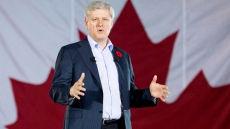
OTTAWA — Justin Trudeau wants this fall's national vote to be the last federal election conducted under the first-past-the-post electoral system.
And, if the Liberal leader becomes prime minister, it may also be the last election in which Canadians can choose not to vote, as well as the last in which the only way to vote is by marking an X on a paper ballot.
Changing the way Canadians vote is just one element of a sweeping, 32-point plan to "restore democracy in Canada" that Trudeau announced Monday.
Some of the measures have been previously announced, such as strengthening access-to-information laws; empowering backbench MPs by allowing more free votes and beefing up legislative oversight by Commons committees; and ending partisanship in the scandal-plagued Senate.
Others are new or build upon previous commitments. Among other things, Trudeau promised a Liberal government would:
— Reform question period in the House of Commons so that one day each week would be devoted solely to grilling the prime minister.
— Impose spending limits on political parties between elections, not just during election campaigns.
— Appoint an equal number of men and women to cabinet and adopt a government-wide appointment policy to ensure gender parity and greater representation of aboriginal people and other minorities.
— Create performance standards for services offered by the federal government, complete with streamlined application processes, reduced wait times and money-back guarantees.
— Create individualized, secure online accounts for Canadians who want to access all their government benefits and review key documents.
Perhaps the most ambitious promise, however, is Trudeau's vow to do away with first-past-the-post (FPTP) in time for the next election.
The current system badly distorts voters' choices, allowing a party to win the majority of seats in the House of Commons with less than 40 per cent of the vote, and delivering wildly different seat counts to parties that win similar shares.
Trudeau promised he'd introduce electoral reform legislation within 18 months of forming government. The legislation would be based on the recommendations of a special, all-party parliamentary committee mandated to fully and fairly study alternatives to first-past-the-post, including ranked ballots and proportional representation.
The committee would also explore the notions of mandatory voting and online voting.
The Liberal party sought grassroots reaction to the notion of legally compelling Canadians to vote, as is done in Australia, in a survey last summer. But Trudeau has not committed to take it any further until now.
The survey followed an analysis by one of Trudeau’s senior policy advisers, University of Ottawa academic Robert Asselin, who advocated mandatory voting and the introduction of preferential or ranked ballots as ways to re-engage Canadians in the political process.
Turnout in federal elections has plunged from a high of almost 80 per cent of eligible voters in 1958 to a record low of 58.8 per cent in 2008, according to Elections Canada. It rebounded slightly in 2011 to 61.1 per cent.
Under Asselin's proposal, eligible voters would be legally required to vote but would have the option of voting for "none of the above." Those who didn't vote would face a small fine.
Electronic voting has also been touted as a way to entice busy Canadians to cast ballots. But Prime Minister Stephen Harper's Conservative government last year effectively scotched Elections Canada's plans to experiment with online voting, requiring any such tests to be approved by Parliament.
First-past-the-post has long been viewed as the primary culprit behind declining turnout, contributing to Canadians' belief that their votes don't count.
Trudeau personally favours replacing it with preferential balloting, in which voters rank their first, second, third and subsequent choices. If no candidate receives an absolute majority on the first ballot, the last-place candidate is eliminated and his or her supporters' second-choice votes are counted. That continues until one candidate receives over 50 per cent.
However, Trudeau has also said he's willing to consider proportional representation, a more complex reform for which there are a variety of possible models. Essentially, it involves electing multiple representatives for each constituency, with the seats divvied up in proportion to the share of votes won by each party in each riding.