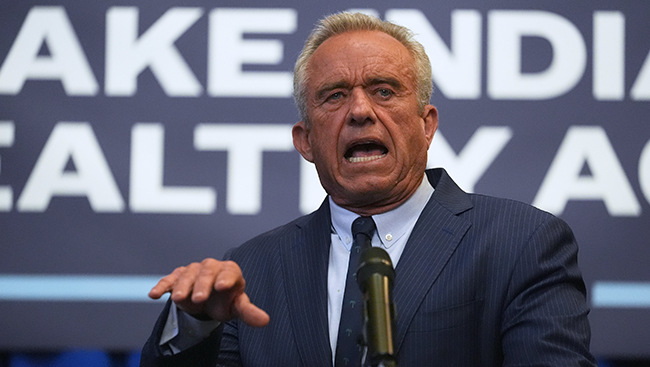
ATLANTA (AP) — A key vaccine advisory committee met forthe first time under new U.S. Health Secretary Robert F. Kennedy Jr., a leading voice in the U.S. anti-vaccine movement.
Tuesday's meeting was, to some extent, business as usual, though with a major question looming: Who would evaluate the committee's recommendations?
The Advisory Committee on Immunization Practices' two-day meeting took up vaccine policy questions that had been put on hold when the U.S. Department of Health and Human Services abruptly postponed the panel's February meeting.
“It will be striking” if the meeting is routine, given “signals and alarms” that suggest changes and perhaps reductions in federal vaccination efforts, said Jason Schwartz, a Yale University health policy researcher who studies government health agencies.
But Tuesday's meeting started fairly routine, with most members joining through a webcast. They discussed an mpox vaccine and how the winter flu and COVID-19 seasons were going.
CDC official asks about COVID-19 vaccines
The conversation took a turn when a CDC official summarized a committee workgroup discussion about the waning COVID-19 pandemic, and asked whether the panel might consider changing vaccination recommendations. For example, instead of recommending seasonal shots for all Americans 6 months and older, should the recommendations be more focused — at least for certain age groups — on people with chronic illnesses or otherwise at higher risk?
“I guess I am surprised we're considering a risk-based recommendation," said committee member Dr. Denise Jamieson, dean of the University of Iowa’s medical school.
She worried it will be harder to implement, and may cause more headaches for patients who want to get shots and have them covered by insurance.
Dr. Jamie Loehr, a family medicine doctor in Itasca, New York, said he is happy the committee is considering a risk-based recommendation but also worried about feasibility and themessage it would send.
“COVID is still a fairly dangerous disease and very, very common,” he said. "We are not talking about 10 cases of mpox. We are talking about thousands of hospitalizations and deaths.”
A vote on the idea could come at the next committee meeting, scheduled for June.
Who will take up the committee's recommendations?
The 15-member panel of outside scientific experts, created in 1964, makes recommendations to the director of the Centers for Disease Control and Prevention. CDC directors almost always approve those recommendations on how Food and Drug Administration-cleared vaccines should be used. TheCDC's final recommendations are not binding, but for decades they have been widely heeded by doctors and determine thescope and funding of vaccination programs.
The committee was slated to vote Wednesday afternoon on whether to make new recommendations regarding three kinds of vaccines, including one for meningitis and another to prevent a mosquito-borne illness called chikungunya.
It's not clear who would decide whether to accept those recommendations.
The Trump administration named Susan Monarez as acting CDC director in January, and last month picked her to lead theagency. But while she’s awaiting Senate confirmation, Monarez has essentially recused herself from regular director duties because of federal law around vacancies, said two CDC officials, speaking on condition of anonymity because they were not authorized to discuss agency matters and feared being fired.
That means any committee recommendations made Wednesday seems likely to fall to Kennedy. When an AP reporter asked an HHS spokesperson, he said he was looking into the question but did not immediately have an answer.
During his Senate confirmation hearings, Kennedy told lawmakers he is not “antivaccine.” But since taking office, he has promised to “investigate” children’s shots and to take a new look at the possibility of links between childhood vaccinations and autism — a theory that has been debunked by a number of studies, including at least a dozen that involved CDC researchers.
The panel’s chair, Dr. Helen Keipp Talbot of Vanderbilt University, said she didn't know who would decide whether to sign off on any recommendations.