
Saturday, July 4, 2026
ADVT 
National

Last spring forward for B.C. as it moves to permanent daylight time

Darpan News Desk The Canadian Press, 02 Mar, 2026 03:55 PM
  • Last spring forward for B.C. as it moves to permanent daylight time

British Columbia's major southern population centres will be facing winter sunrises around 9 a.m. — and around 9:30 a.m. in the north — after the decision to adopt year-round daylight time, springing forward by one hour this Sunday for the last time.

Premier David Eby said Monday the decision is about making life easier for families, reducing disruptions for businesses and supporting a stable, thriving economy.

"British Columbians have been clear that seasonal time changes do not work for them,” Eby said. 

B.C.'s transition to the Pacific time zone — as opposed to the current Pacific standard and Pacific daylight zones — will put it in the same time zone as the Yukon. It will match Alberta from November to March.

The province will align with California, Washington, and Oregon from March to November, but be an hour ahead outside those months.

The change means that on the shortest day of the year, Dec. 21, the sun will not rise in Victoria until 9:03 a.m. In Prince George, the winter solstice sunrise will be at 9:28 a.m.

Eby says people and businesses will have eight months to prepare for the elimination of the next time change, which had been set for Nov. 1.

He said he’s hopeful B.C.’s American neighbours will join the province in ending the disruptive time changes. 

Attorney General Niki Sharma said they've heard from an overwhelming majority of people in B.C. who want to end the back-and-forth of seasonal time changes.

“This shift offers more stability, supports public well-being and reduces twice-yearly, unnecessary disruptions to the routines of parents, shift workers, small businesses, pet owners and so many more," Sharma said. 

She said she looks forward to enjoying an extra hour of sunlight after work and school for many winters to come. 

The pending change fulfils a promise first made in 2019, when Eby, then attorney general, tabled legislation to make daylight time permanent to end the practice of changing clocks twice a year.

But B.C. conditioned that change on Washington State, Oregon and California also making the switch, which has not happened because the relevant legislation remains in Congressional limbo.

"The situation on the ground has changed since 2019," Eby said, when asked about government's decision to move ahead without waiting on the U.S. states.

"We are able to be a little bit more selfish in our decisions for what is best for British Columbians. It's clear that British Columbians know what is best for them. They want to have that extra hour of sunlight at the end of the day."

Parts of the business community, however, are criticizing the change. 

Bridgitte Anderson, president and CEO of the Greater Vancouver Board of Trade, said government's "unilateral change" marks an "unwelcome distraction that will make it more difficult to attract and retain businesses" in British Columbia.

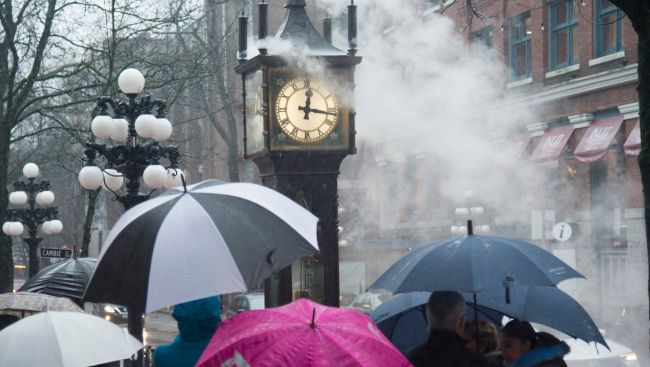
Picture Courtesy: THE CANADIAN PRESS/Jonathan Hayward

MORE National ARTICLES

Fire destroys historic Kamloops bridge

Fire destroys historic Kamloops bridge
An early morning fire has destroyed a historic bridge in Kamloops. The blaze is believed to have started in the middle of city's Red Bridge at around 3 a-m, eventually engulfing the wooden structure that had two lanes for vehicles.

Fire destroys historic Kamloops bridge

B.C. Premier touts involuntary care plans at convention, days before campaign begins

B.C. Premier touts involuntary care plans at convention, days before campaign begins
B.C. Premier David Eby says several city governments are on board with having a "secure site" to house and treat severely mentally ill and drug addicted people.  Eby told local politicians at the Union of B.C. Municipalities conference in Vancouver that public safety is a priority for cities, especially in downtown cores, where many people are seen "visibly" struggling with addictions. 

B.C. Premier touts involuntary care plans at convention, days before campaign begins

Climate, food security, Arctic among Canada's intelligence priorities, Ottawa says

Climate, food security, Arctic among Canada's intelligence priorities, Ottawa says
The pressing issues of climate change and food security join more familiar ones like violent extremism and espionage on a new list of Canada's intelligence priorities. The federal government says publishing the list of priorities for the first time is an important step toward greater transparency.

Climate, food security, Arctic among Canada's intelligence priorities, Ottawa says

B.C. and First Nations reach deal to sell 2,600 condos at 60% of market value

B.C. and First Nations reach deal to sell 2,600 condos at 60% of market value
An agreement between First Nations and the British Columbia government will see thousands of homes made available in Vancouver at 40-per-cent below cost. Premier David Eby calls it a "remarkable" accomplishment between the province and the Musqueam, Squamish and Tsleil-Waututh First Nations, which would see about 2,600 homes sold for 60 per cent of the value in one of the most expensive real estate markets in the world. 

B.C. and First Nations reach deal to sell 2,600 condos at 60% of market value

NDP flips, BC United flops, B.C. Conservatives surge as election campaign approaches

NDP flips, BC United flops, B.C. Conservatives surge as election campaign approaches
If the lead up to British Columbia's provincial election campaign is any indication of what’s to come, voters should expect the unexpected.  It could be a wild ride to voting day on Oct. 19.

NDP flips, BC United flops, B.C. Conservatives surge as election campaign approaches

Canada makes small emissions cut in 2023, but must ramp up to hit key targets: report

Canada makes small emissions cut in 2023, but must ramp up to hit key targets: report
Hikes to oil production and rebounding air travel put a drag on Canada's climate progress last year, a report published Thursday by a leading policy institute found, though the country was still able to make a modest cut to its planet-warming emissions. The new estimates from the Canadian Climate Institute show Canada cut emissions by about 0.8 cent last year compared to 2022, or eight per cent since 2005. 

Canada makes small emissions cut in 2023, but must ramp up to hit key targets: report