The Liberal government is promising to finally spend $10 billion that has sat in the accounts of its infrastructure financing agency for years, hoping to create thousands of post-pandemic jobs.
Prime Minister Justin Trudeau said the three-year plan would create 60,000 jobs by expanding access to high-speed internet, building out agricultural irrigation infrastructure in western provinces and greening transit fleets.
He didn't outline any specific projects — or any new money — but highlighted priority areas in which the bank intends to invest.
The reshaped spending will front the costs for things like energy retrofits of buildings, offer low-cost financing for the purchase of zero-emission buses, or de-risk agriculture projects with uncertain returns due to commodity price fluctuations.
All told, the government has retooled $10 billion from the bank's allocation of $35 billion, some of which had already been earmarked for rural broadband and greening transit fleets.
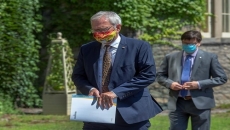
Michael Sabia, chairman of the Canada Infrastructure Bank board, vowed the money wouldn't sit idle. He said he expected the agency to announce projects by the end of this year.
"There is a substantial amount of work that has been done on that, but there is a substantial amount of work to do," Sabia said Thursday at a news conference in Ottawa.
"To get that investment program moving … that's our top priority."
Sabia, the former head of Quebec's pension fund, was named chairman of the board in April amid a shakeup of the infrastructure bank's senior executives. A new chief executive has yet to be named.
At that time, he and the government predicted that the bank would play a major role in stimulating the economy after the pandemic.
The Liberals created the agency in 2017 to entice funding from private-sector partners, particularly big institutional investors like pension funds, to pay for what the government called "transformational" infrastructure projects.
However, the bank has been criticized for the relatively few investments it has made thus far, in just nine projects. During last fall's federal election campaign, both the Conservatives and the NDP promised to abolish the bank if elected.
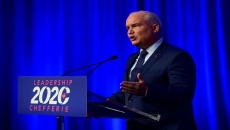
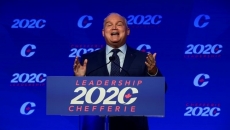
Conservative Leader Erin O'Toole reiterated that promise on Thursday, calling the Liberals' plan just another re-announcement.
"Construction workers in New Brunswick, commuters in Montreal, and agricultural workers in the Prairies don’t need more Liberal hashtags and photo ops," he said in a statement.
"They need an actual plan to build roads, bridges, and railways."
The Liberals say the investment plan is part of the government's promise in last week's throne speech to create one million jobs and revive an economy ravaged by the COVID-19 pandemic. It is also intended to help the government meet its goal of net-zero carbon emissions by 2050.
Among the new allocations are $1.5 billion for agricultural infrastructure in the West, and $2.5 billion for clean power, or half the $5 billion previously given for so-called green infrastructure.
There is also $2 billion for broadband to connect some 750,000 households and businesses, up from the $500 million the bank in 2018 was asked to invest. The Liberals promised in summer 2019 to spend $6 billion through to 2030 to expand broadband to all corners of the country.
A further $500 million is to help speed up the things that need to be done before starting construction, such as studies and technical reports.
Sabia said projects that get the bank's backing would require them to contribute to economic growth, draw in private capital to turn $1 of public funding into $2 or $3 of spending, and help the bank earn back what it pays out.
He said the bank has already started the work needed to identify and review proposed and existing projects.
"The analyses have been done because we know where these projects are," Sabia said. "So this plan, as I said, is very real, very concrete, bottom-up build and we have a lot of confidence in it."
New Democrat infrastructure critic Taylor Bachrach said the infrastructure bank has proven to be the wrong tool for getting projects built.
"The public-private approach the Liberals continue to push consistently ends up costing Canadians more over the long term, while private investors can make millions," he said.
Bloc Québécois critic Xavier Barsalou-Duval said in a statement that provinces and cities need direct and unconditional federal funding to pay for projects. Instead, Barsalou-Duval said, the Trudeau Liberals are offering more loans.