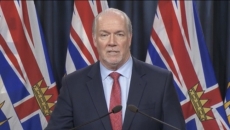
The Liberal government taking steps toward promised changes to federal drug policy, while looking at how to reduce opioid-related deaths during the pandemic.
The federal government launched a national consultation on supervised-consumption sites this week, saying they would be seeking comments from a variety of Canadians, including those who operate the sites — and those who use them.
"The evidence shows us that supervised-consumption sites and services save lives and can provide people who use drugs with access to health and social services and treatment," federal Health Minister Patty Hajdu said in a statement Thursday.
"As we see the COVID-19 outbreak worsening the situation for Canadians struggling with substance use disorders, it is more important than ever to ensure support is available. The feedback we are gathering from communities across Canada will help us to better understand how we can continue to help Canadians and save lives."
The federal government also announced Thursday it was committing $582,000 in funding for a new Toronto project to offer a safe supply of opioids to reduce overdose deaths during the COVID-19 pandemic.
Health Canada also granted a federal exemption to a Toronto health-care centre to operate an overdose-prevention site at a COVID-19 isolation shelter until late September.
Separately, federal prosecutors are now being instructed to criminally prosecute only the most serious drug possession offences and to find alternatives outside the criminal justice system for the rest.
That directive is contained in a new guideline issued by the director of public prosecutions, Kathleen Roussel, who is independent from the federal Justice Department.
"The approach set out in this guideline directs prosecutors to focus upon the most serious cases raising public safety concerns for prosecution and to otherwise pursue suitable alternative measures and diversion from the criminal justice system for simple possession cases,'' the guideline states.
In all instances, the guideline says alternatives to prosecution should be considered if the possession offence involves a person enrolled in a drug treatment court program or an addiction treatment program supervised by a health professional.
The same applies in cases that involve a violation of bail conditions and can be addressed adequately by a judicial referral hearing, as well as cases where the offender's conduct can be dealt with by an approved alternative measure, including Indigenous and non-Indigenous restorative justice responses.
The guideline says criminal prosecution for possession of a controlled substance "should generally be reserved for the most serious manifestations of the offence.'' It says cases would be considered serious if a person caught in possession of an illegal drug was engaged in conduct that could endanger the health or safety of others.
The guideline specifies six types of conduct that would generally warrant criminal prosecution:
— Conduct that poses a risk to the safety or well-being of children or youth, such as being in possession of an illicit drug in the vicinity of places frequented by youths or being a person in a position of trust or statutory authority with respect to children.
— Conduct that puts the health or safety of others at risk, such as driving or preparing to drive while impaired, supervising another person driving, operating machinery, possessing a weapon or performing an activity that poses a risk to public health or safety.
— Conduct that "poses a heightened risk'' to a community's efforts to combat illegal substance use, an issue that often arises in isolated and remote communities.
— Conduct where there's "a factually grounded basis to associate it'' with another drug offence, including cultivation, production, harvesting, trafficking or importation of a controlled substance.
— Conduct in breach of rules in "a regulated setting'' such as jail or prison.
— Conduct committed by a peace officer or public officer that is relevant to the discharge of their duties.
The purpose of the guideline is to articulate "a principled prosecutorial litigation approach to the well-documented realities about the health impact of substance use while acknowledging that certain drug use may present particular public safety concerns.''
That seems consistent with the federal Liberal government's approach to illegal drugs as being more a public health issue than a criminal one.
In their first mandate, the Liberals legalized the recreational use of cannabis. However, Prime Minister Justin Trudeau rejected calls to decriminalize possession of other harder drugs, despite a resolution passed at the last Liberal convention calling for such an approach.
Instead, the Liberal platform in last fall's election promised to make drug treatment court the default option for first-time non-violent offenders charged exclusively with simple possession. It also promised to help drug users get quick access to treatment.
.jpg "Federal prison tensions rise amid COVID lockdowns; activists want releases")