OTTAWA - Canada's chief public health officer says provinces are going to have to find a balance between containing the virus with public health measures and returning to a sense of normalcy as the Omicron wave continues to crest.
Several provinces have signalled their intention to do away with some, if not all, remaining COVID-19 health restrictions.
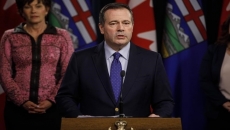
Alberta Premier Jason Kenney says his government will announce next week a date to end the province's COVID-19 vaccine passport, as well as a phased approach to ending almost all COVID-19 health restrictions by the end of the month, provided the pressure on hospitals continues to decline.
Meanwhile Saskatchewan Premier Scott Moe says he's committed to ending all COVID-19 restrictions soon, even while COVID-19-related hospitalizations are at their highest level since the pandemic began.
While health experts say vaccines greatly prevent severe illness, hospitalization and death, chief public health officer Dr. Theresa Tam said two doses offer little protection against infection from Omicron, and boosters work against transmission only for a period of time.
Two doses of an mRNA vaccine are 75 to 80 per cent effective against severe illness from Omicron, according to Canada's National Advisory Committee on Immunization. A third dose is at least 90 per cent effective at preventing hospitalization, including for the variant, the U.S. Centers for Disease Control has reported.
Tam said vaccine mandates should be re-evaluated over time, but they must be weighed against the potential effect on fragile health systems and how many serious cases they can handle.
"I do think that prior to vaccinations, prior to getting some more treatments, and of course some immunity afforded by Omicron, that balance was very, very difficult to achieve," Tam said at a virtual briefing Friday.
"I am optimistic that it will become easier to achieve better balance."
Even though the number of new infections is trending down, there are still a daily average of about 10,000 new reported cases across Canada, Tam said.It is difficult to get a full picture of how many cases there are in Canada, as many jurisdictions have limited access to molecular tests for essential and at-risk people only.
More than 10,000 people are also being treated in hospital for COVID-19 each day as of Wednesday, she said.
Even as measures are dropped, provinces need to find ways to optimize vaccination levels, she said.
More than 88 per cent of Canadians over the age of five have received at least one dose of a COVID-19 vaccine, the latest data from the Public Health Agency of Canada shows.
There is no Health Canada-approved COVID-19 vaccine for young children under five years old.
The National Advisory Committee on Immunization issued new guidance Friday about how long people who have been infected with the virus should wait to get a COVID-19 vaccine.
The advice varies based on how old the person is, whether or not they are immunocompromised and how many vaccine doses they received before they were infected.
Moe said in a video posted to social media that COVID-19 is not going away, but people are done with having to follow public health orders, so "normalizing" the virus and learning to live with it is the achievable option.
The Saskatchewan Medical Association, however, is warning that loosening health measures would strain the province's health-care system.
In Alberta, Edmonton Mayor Amarjeet Sohi urged the provincial government to "reconsider lifting restrictions too soon and too fast."
"We must look out for our most vulnerable. We must protect our children under the age of five who still don't have the opportunity to get vaccinated," Sohi wrote in a statement.
Sohi, a former federal Liberal cabinet minister, asked city administration to look into what options Edmonton has to institute its own restrictions if the provincial measures are lifted.
Kenney said a patchwork of COVID restrictions across the province would be confusing for people and, besides, it's not the city's job.
"Provinces are in clearly the best position to make difficult decisions about how to manage COVID-19, and I really don't think that is something municipal governments are responsible for or necessarily equipped to do," Kenney said, speaking after a meeting with his fellow Canadian premiers.
Ontario and Quebec, which have seen a slight decline in COVID-19-related hospitalizations this week, have both eased some restrictions. However, scientists and health officials in the two provinces have warned that cases will likely rise again as partial reopenings progress.
Newfoundland and Labrador is set loosen restrictions on businesses and group sizes on Monday, though Premier Andrew Furey, who is also an orthopedic surgeon, said that any changes must be done with caution.
Vaccine mandates are not meant to be a punishment, federal Health Minister Jean-Yves Duclos said Friday at the briefing. Rather they are meant to protect people and incentivize them to get vaccinated against COVID-19.
The federal government has imposed mandates at international borders, on planes, passengers trains, cruise ships and within the public service. Duclos said discussions about vaccine mandates would be ongoing at the federal level.
Premiers who met today as part of the Council of the Federation did not specifically discuss international travel restrictions. Chair of the federation, British Columbia Premier John Horgan, said federal and provincial governments need to protect people while ensuring their liberties are intact.
"We need to reimagine the tools at our disposal as citizens and as provinces and as a federal government," Horgan said.
Kenney was more emphatic. He said the travel restrictions are not effective given the prevalence of Omicron within Canada.
"The notion that we can interrupt or reduce community transmission through very rigid travel protocols, I think, is unrealistic," he said.
Any changes to the testing and vaccine requirements for international travel would depend on the epidemiological situation in Canada and abroad, as well as health-care capacity, Tam said.
High-level discussions about health mandates are happening against the backdrop of several anti-mandate protests cropping up across Canada, including a demonstration in Ottawa that local politicians have taken to calling an "occupation."