As the impasse between Republicans and Democrats pushed into its 36th day on Wednesday, one expert warned that the U.S. government shutdown — now the longest in the nation's history — could upset some Canadians' travel plans.
It's not clear how long the shutdown will last as federal workers miss another paycheque and as Americans face the prospect of a busy holiday season at airports coupled with a shortage of air traffic controllers and airport staff.
CNN reported that last weekend saw the worst air traffic controller shortages since the shutdown began on Oct. 1.
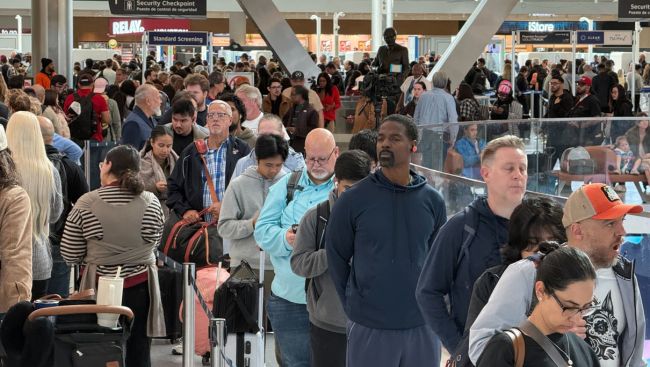
Pictures shared on social media show massive lines at airports. Flight delays and cancellations are piling up. Houston's George Bush Intercontinental Airport warned passengers Sunday it could take three hours to get through security checkpoints because of staffing issues.
Even though many Canadians have been avoiding travel to the United States due to President Donald Trump's tariffs and threats of annexation, they may not be able to avoid the cascading effects of the shutdown.
John Gradek, a McGill University lecturer in aviation management, said the North American air travel system is integrated. American airport delays affecting planes destined for Canada could cause cascading delays throughout the Canadian system.
Gradek said that's not the only problem.
If someone is flying from southern Ontario to Western Canada, he said, "a significant portion of that flight is overflying U.S. airspace." Canadian travellers looking to warm up in Mexico also fly over the United States.
"In normal times, the handoff between Canadian and U.S. air traffic controller is seamless," Gradek said.
If the specialized air traffic controllers who handle that part of American airspace stop showing up to work, it could hinder Canadians' travel plans, he said.
"If there's a slowdown or a reduction in air traffic control capabilities in places like Albuquerque, for example, that would in fact affect the ability of Canadian carriers to operate in American airspace as they transit U.S. airspace, not necessarily as they go into and out of the U.S.," he added.
Transport Canada is aware of the situation and is closely monitoring it through its 24/7 Operations Centre, said department spokesperson Hicham Ayoun in an emailed statement.
Ayoun said travellers leaving Canadian airports should check the status of their flights in advance.
Democrats and Republicans continue to blame each other for the shutdown, which has brought many government agencies to a standstill, left hundreds of thousands of public servants furloughed and put federal food benefits at risk for millions of Americans.
Republicans claim their bill to extend federal funds is not controversial, but Democrats say they won't support the legislation unless it includes an extension for expiring health care benefits.
Trump told the CBS program "60 Minutes" he would negotiate health care benefits only once the government is open. The president predicted Democrats would capitulate to Republicans.
"I think they have to," Trump said during the interview, which aired Sunday. "And if they don't vote, it's their problem."
Airport staff were key to ending the government shutdown during Trump’s first administration. That shutdown — which previously held the record as the longest — began when the president demanded that Congress give him money for a U.S.-Mexico border wall.
During that 35-day shutdown from late 2018 into early 2019, employees deemed essential — including air traffic controllers and Transportation Security Administration staff — were required to continue working without pay.
They started calling in sick at a higher frequency, leading to significant airport delays.
A similar situation has been playing out during the current shutdown, with an increasing number of ground stops called in airports across the United States because of staffing issues.
The U.S. Federal Aviation Administration was already dealing with a shortage of air traffic controllers before the shutdown. The administration posted on social media on Oct. 31 that "nearly 13,000 air traffic controllers have been working without pay for weeks."
It said half of the agency's core 30 facilities were experiencing staffing shortages, and nearly 80 per cent of air traffic controllers were absent at New York-area facilities that day.
"The shutdown must end so that these controllers receive the pay they’ve earned and travellers can avoid further disruptions and delays," the agency posted.
Transportation Secretary Sean Duffy told media outlet CNBC on Monday that there’s been a “rolling thunder throughout the system.”
Duffy has been warning of flight disruptions as air traffic controllers continue to go without paycheques.
Picture Courtesy: AP Photo Lekan Oyekanmi