

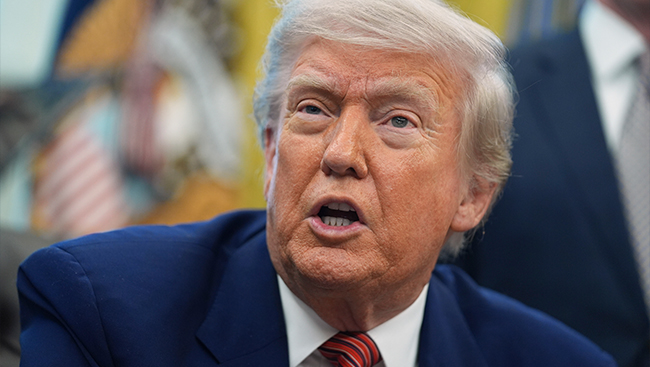
Almost two in five Canadians say recent court rulings in the U.S., and the ongoing legal battle over President Donald Trump’s tariffs, have made them feel less confident in the future of trade relations, a new poll suggests.
The poll suggests that 38 per cent of Canadians say they feel less confident now about the future of Canada-U.S. trade as well as trade between the U.S. and other countries.
Sixteen per cent of Canadian respondents say they feel more confident, while 37 per cent say their level confidence in the future of the trade relationship hasn't changed.
The Leger poll, which was conducted online and can't be assigned a margin of error, surveyed more than 1,500 people between May 30 and June 1.
The poll also surveyed more than 1,000 Americans. Their responses to the poll were substantially similar.
Thirty-six per cent of American respondents said the recent court rulings and the ongoing legal battle over Trump’s tariffs made them feel less confident about the future of trade with Canada and with the rest of the world. Another 19 per cent reported feeling more confident and 31 per cent said their opinion hadn't changed.
Trump's tariffs are still hitting most countries around the world after a federal appeals court temporarily paused a decision last week by the U.S. Court of International Trade to block his tariffs.
The court said Trump went beyond his authority when he used the International Emergency Economic Powers Act of 1977 to take his trade war to the world.
A federal appeals court granted the Trump administration's emergency motion for a temporary stay, allowing those tariffs to stay in place for now.
The poll suggests that Albertans are reporting the lowest level of confidence in the state of trade relations — 48 per cent of them told Leger they feel less confident about the future of Canada—U.S. and U.S.–international trade relations. That's compared to 38 per cent of Quebecers, 37 per cent of Ontarians and 35 per cent of people in B.C.
Among Canadians 55 years of age and older, 43 per cent reported feeling less confident in trade relations; just 33 per cent of Canadians aged 18 to 34 said the same. More women than men said they were losing confidence.
While many Canadians expressed concern about the future of trade relationships, many also said the fact that U.S. courts are trying to limit Trump’s impact on trade policy increases their trust in America's institutions.
The poll suggests that 45 per cent of Canadians say their trust in U.S. democratic institutions has increased, while 17 per cent say it has decreased. Almost a third of Canadians said it has had no impact on their opinion.
Quebecers were the most likely to say their trust had increased, at 54 per cent, compared to 45 per cent of people in B.C., 43 per cent of Ontarians and 39 per cent of Albertans.
Canadians aged 55 and over were more likely to say their trust had increased than younger Canadians.
Among the Americans surveyed, 38 per cent said the fact that U.S. courts are trying to limit Trump’s trade powers increases their trust in U.S. democratic institutions. Another 24 per cent said it decreases their trust and 26 per cent said it had no impact on their opinion.
Andrew Enns, Leger's executive vice-president for Central Canada, said that if there had been only one ruling — the one that blocked the tariffs — the confidence levels recorded by the poll might have been higher.
"There was a second ruling and I think, if anything, it's left people a bit uncertain about the situation," Enns said, noting that levels of concern seemed to be higher earlier in the year.
"I think the confidence, it's going to take some time to rebuild that."
The polling industry's professional body, the Canadian Research Insights Council, says online surveys cannot be assigned a margin of error because they do not randomly sample the population.
Picture Courtesy: AP Photo/Evan Vucci, File


