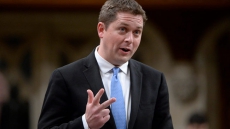
MONTREAL — When Maxime Bernier, leader of the nascent People's Party of Canada, recently appeared on a Quebec TV news panel, the pundits laughed at his suggestion that Ottawa could force an oil pipeline through the province.
The host barely contained a smirk as he accused Bernier of wanting to shove a pipeline "down the throats" of Quebecers. "At the end of the day," Bernier replied, "the federal government has the right to approve a project or not."
No other leader — federal or provincial — with ambitions in Quebec would dare say something like that in public, but for Bernier the comments perfectly captured his big gamble. He is betting there are enough alienated voters in his home province and across the country fed up with status-quo politicians.
Bernier, 55, who represents the federal riding of Beauce, south of Quebec City, slammed the door on the Conservative party on the eve of its August convention. The Tories, he said, were "too intellectually and morally corrupt to be reformed," and on Sept. 14 he launched the PPC.
"It's a challenge to do politics differently," Bernier told The Canadian Press during a recent interview in Montreal. "You saw the reactions of those pundits when I expressed a totally normal point of view," he said referring to his pipeline stance.
While he calls his policies normal, they are designed to upend the Canadian order. He proposes a drastic reduction in immigration to Canada, cutting levels by more than 40 per cent from the Liberal government's current target of 330,000 people in 2019. "I'm the only one who is saying, 'Let's take fewer immigrants,' " he said. "We want people to integrate, we don't want ghettos in Canada."
He calls his policies "smart populism," promising to shrink the size the federal government to such an extent that provinces would have no choice but to develop their own natural resources or find other ways of creating wealth. A PPC government would stop transfers to fund provincial health care.
Instead, it would give tax points to the provinces so they can collect their own health revenues. And it would not use federal dollars to pay for local infrastructure projects. Ontarians shouldn't be paying for provincial roads in New Brunswick, he says.
Another of Bernier's core principles is to make the federal equalization program less generous. Under the program, Ottawa redistributes part of the tax money it collects to poorer provinces to ensure citizens across the country are offered comparable services.
Citizens in Alberta, who have among the top median household incomes in the country, receive nothing from equalization. In Bernier's home province, where successive governments have rejected proposals to develop the province's shale-gas or oil potential, the government is set to receive more than $13 billion in equalization in 2019.
"We need to change the (equalization) formula to create incentives so that other provinces develop public policies that create wealth," Bernier said. "It's a unique vision. We are the only party promoting that."
One reason no other party has taken up the PPC's ideas could be because they would create deeper inequalities across the country, says Francois Vaillancourt, an economist with the Montreal-based research institute Cirano.
If a PPC government transfers tax points to the provinces, wealthier places such as Alberta and British Columbia would be able to collect more money per capita than the have-nots. "If you reduce equalization and transfer tax points to the provinces, that means you accept more inequalities between rich and poor provinces," Vaillancourt said in an interview.
Vaillancourt, however, says Bernier is correct that equalization doesn't encourage provinces to create wealth. "If you do nothing to become richer, you are not penalized," he said. "In the current system there is nothing that motivates a province to develop more economically than they are now."
Bernier cites Quebec as a prime example, saying the province would be more open to drilling for oil on Anticosti Island or developing its shale gas resources along the St. Lawrence Valley if not for the cushion of equalization.
Rather than exacerbate inequalities, Bernier says his policies would leave all Canadians with more money in their pockets.
Ending supply management in Canada — the system that sets prices for poultry, eggs and dairy and blocks foreign competition — would reduce grocery bills, he says. Cutting corporate taxes would attract more foreign investment and create jobs. Reducing regulation in the telecom industry and privatizing airports would open the door to competition and lower prices, he argues. And abolishing federal subsidies to corporations, he says, would save billions for regular Canadians.
He has 10 months before the next election to convince enough Canadians he's right, and his first challenge is finding the disenchanted who have stopped voting. "Thirty per cent of Canadians didn't vote in the 2015 election," Bernier said. "That's our clientele, because we are doing politics differently."
Bernier claims his party is picking up momentum, with roughly 34,000 members and more than $540,000 collected in donations. He also boasted in a fundraising email sent Dec. 23 that the PPC had reached its goal of setting up riding associations in all 338 federal ridings across the country.
Opinion polls, however, indicate Bernier has much more work to do. The CBC's poll-aggregating website puts support for the PPC at 1.5 per cent nationally. A Dec. 20 poll by Ipsos didn't even include the PPC as a voting option.
While he is most popular in Alberta at the moment, he believes he can draw support across the country — even in Quebec, where his pipeline politics upset the political class.
Premier Francois Legault dismisses Alberta's "dirty energy" that would have flowed through the Energy East pipeline, which was shelved following strong opposition in Quebec. But Bernier says many people in Quebec support the project; their voices were just drowned out by environmentalists and the "elite" pundits on television.
He seems to revel in the response he provokes from those elites, claiming they fail to grasp what is at stake. "I think it's motivating and exalting when we defend ideas that are at the foundation of western civilization," he said.