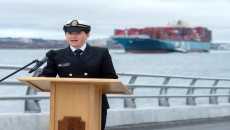
The Defence Department's top civilian official is touting the importance of continued investments in the Canadian Armed Forces, and says she has received no indications the Liberal government is planning to cut spending because of the COVID-19 crisis.
The comments by Defence Department deputy minister Jody Thomas come amid questions about how the Liberal government plans to find the tens of billions of dollars doled out in recent months to support Canadians during the pandemic.
The emergency support, estimated at $153 billion at last count, has far surpassed expected government spending and significant belt-tightening is likely after the crisis as Ottawa will start searching for ways to keep the country from drowning in red ink.
Military spending was previously slashed in the 1990s as Jean Chretien's Liberal government wrestled with massive deficits while Stephen Harper's Conservative government followed a similar course after the 2008-09 financial crash.
That has prompted concerns within defence circles that the pattern will repeat itself after COVID-19, with fears the Liberals will lean heavily on the country's $29-billion defence budget to help get government spending back under control.
In an interview with The Canadian Press, Thomas said she had not received any order or direction to slow or cut defence spending and that officials are continuing to work on the planned purchase of new warships, fighter jets and other equipment.
"We are not experiencing any slowdowns," she said.
"We are continuing very aggressively and ambitiously to continue our plan."
That plan is the Liberals' defence strategy, which it released in 2017. Known as Strong, Secure, Engaged (SSE), the strategy promised $553 billion in military spending over 20 years. Much of that is to buy new equipment such as jets and warships.
"There has been zero indication from anyone that there would be a cut to the budget," Thomas said, adding Defence Minister Harjit Sajjan "has been very clear of his expectations of us to execute on SSE."
She went on to suggest the planned defence spending is actually needed as much now as before the pandemic as the crisis amplifies the already significant global uncertainty that existed before COVID-19.
A scan of recent headlines underscores that uncertainty, from U.S. President Donald Trump's administration suggesting it may pull troops from Germany to China imposing its will on Hong Kong and flexing its muscles in the South China Sea.
There are also ongoing concerns about Russia and the situation in the Middle East.
"Canada has to be equipped," Thomas said. "In a post-COVID world, there is, I would say as the deputy minister of defence, a need for SSE to in fact be done more quickly rather than slow it down or cut the budget."
The government last week tabled its latest request for money in Parliament, which included $585 million for the continued construction of two new naval support ships in Vancouver. The first of those ships is due in 2023.
Defence analyst David Perry of the Canadian Global Affairs Institute said the Liberals have significantly ramped up military spending, but no one knows how fast the economy will recover or how deep Ottawa will be in the hole when the pandemic ends.
"Without knowing more about these things, it's way too early to know what the impact will be to defence," he said.
"But it's a basic fact of Canadian federal budgeting that if a government is looking to reduce all federal spending, DND plays a part in that because it spends the most money."
And while trimming military spending was the route taken by previous governments, there are implications, as evidenced by the age of Canada's CF-18s and other old equipment and its lack of naval support vessels until the new ones are finished.
"Part of the reason we're having issues with procurement today is because of the decisions that were taken before," Perry said.
"The reasons they were taken — rightly or wrongly, I would say largely rightly — in the 1990s to reduce spending then, we're still dealing with the after-effects of it now because we didn't buy stuff then and we're trying to make up for lost time now."