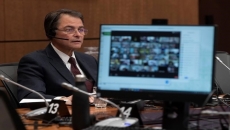
The public health crisis gripping the world and civil unrest roiling cities across the United States are precisely why President Donald Trump should be embracing America's global friends and allies, not tearing down the rules-based international order, says a key member of the congressional committee that oversees global trade.
Rep. Ron Kind, a Democrat from Wisconsin on the House Ways and Means Committee and an advocate for the new U.S.-Mexico-Canada Agreement, says now is precisely not the time for the U.S. and the Trump administration to be isolating the United States, erecting protectionist barriers and abandoning international partners.
"I think psychologically, at a time of national crisis and great anxiety, it's awfully easy politically to demonize outsiders — multilateral institutions, other countries — it's just the typical political fallback position," Kind told a panel of trade experts hosted by the Washington International Trade Association.
"I believe it creates a more dangerous world, and complicates the complex and difficult issues that we have to work on."
The widespread protests in cities all across the U.S. following the May 25 police killing of George Floyd may not at first glance have anything in common with the typically drab issue of international trade.
But deep-seated cultural issues like racial disparity, joblessness and income inequality are directly related to the sense of injustice now being expressed and on visible display in America's urban centres, Kind said, and much of that economic imbalance can be traced back to how the country's trade agenda evolved over the course of the 25-year NAFTA era.
The COVID-19 pandemic, too, has widened the divide, exacting an outsized toll on disadvantaged communities and exposing essential workers who were either required to keep working through the crisis or couldn't afford to stay home to avoid the risk of infection.
"How do we help the workers of today develop the skills they need for tomorrow to be full participants in the global high-tech economy that we find ourselves in and have to compete in?" Kind asked.
"This goes to George Floyd too, and the reaction we're seeing on the streets — the income inequality, the lack of economic opportunity that exists for too many families in our country. They're all asking, what role can they play in the 21st-century global interconnected economy, or are they just going to be left behind?"
Trade experts, including some veterans of the talks that produced the North American revisions to NAFTA taking effect next month, told a similar panel Wednesday that they see the USMCA — known in Canada variously as CUSMA, ACEUM or simply the "new NAFTA" — as a template for future trade deals in jurisdictions around the world.
That's in part because of its unprecedented language on labour and environmental standards, an effort to address some of the perceived shortcomings of its much-maligned predecessor.
But first, people in countries around the world need to be convinced that multilateral trade agreements have merit in the first place, said Jameson Greer, trade ambassador Robert Lighthizer's former chief of staff in the office of the U.S. Trade Representative.
"I think the bigger question is not necessarily whether the USMCA is going to be a template, but what's going to be the appetite politically for additional free trade agreements," Greer said.
I think we still have some threshold questions — do we want to have trade agreements, period. If we say we do, then USMCA for sure is going to be a template. But there are still some broader questions out there."
Kenneth Smith Ramos, who was Mexico's chief negotiator throughout the USMCA process, described the agreement as the most advanced free-trade agreement in the world, something that is "stronger" and "more inclusive" that includes new labour, environmental and anti-corruption standards.
It also includes language to ensure annual evaluations and a six-year review clause — the substitute for the so-called "sunset clause" the Trump administration originally wanted, which would have required completely renegotiating the agreement every five years.
"We implemented the NAFTA and then we just let it run, on automatic pilot," Smith Ramos said.
"Now, we have a six-year review and yearly reviews ... that will analyze how the agreement is being implemented, what needs to be tweaked, do we need new negotiations, do we need to ask civil society for input. I think that is a very important piece in order to recover the public's feelings that trade agreements are living instruments that can be changed over time."