The Immigration Department says more than 24,000 travel documents could be suspended by the federal government's measures to keep Ebola out of Canada.
The government has announced a 90-day suspension of a variety of immigration and travel documents for people in the Democratic Republic of the Congo, Uganda and South Sudan. The suspension took effect at 11:59 p.m. ET on Wednesday.
In an email, a department spokesperson said there were about 12,600 DRC residents and 11,500 Ugandan residents with valid travel documents as of May 19.
The government estimates there were 470 South Sudan residents with valid immigration travel documents as of May 21.
The department spokesperson stressed the measures are based solely on country of residence, not nationality, so people from those three countries who are not currently residing in any of them are not affected.
Suspended documents include electronic travel authorizations and temporary and permanent resident visas for people currently in one of the three listed countries.
The government is pausing decisions on these documents filed from any of the three affected countries but says it will keep processing passports, permanent resident cards and permanent resident travel documents.
Visa extensions for people who are already in Canada will continue to be processed normally.
Anyone coming to Canada from Ebola-affected regions will be required to undergo a 21-day quarantine. That measure is set to expire on Aug. 29.
The spokesperson said the government will continue to monitor the public health situation, citing increased international travel for the FIFA World Cup, which Canada is co-hosting with the United States and Mexico.
The three countries issued a joint statement Thursday saying they have aligned their travel measures for people coming from Ebola-hit regions of Africa.
Health Minister Marjorie Michel said the U.S., which implemented restrictions weeks earlier than Canada, did not pressure Canadian officials to follow suit. She said she spoke with her Mexican counterpart and they agreed on the need for similar measures.
She said the World Cup is "the key element" of the three countries' response.
"Even if Canada still remains low-risk ... we are taking all the precautionary measures and we are aligning with the U.S. and Mexico," she said.
This mass suspension of travel documents marks the government's first use of powers it granted itself through its border legislation C-12, which passed in late March.
The new law says the government has the ability to modify immigration documents in bulk when it is deemed to be in the public interest and approved by cabinet. The reasoning and timeline for any changes must be clearly defined, according to the law.
In committee testimony before the bill became law, Immigration Minister Lena Diab cited the COVID-19 pandemic as a situation where this power would have been useful.
Critics have argued the power could be abused by the government due to the broad definition that could be applied to "public interest."
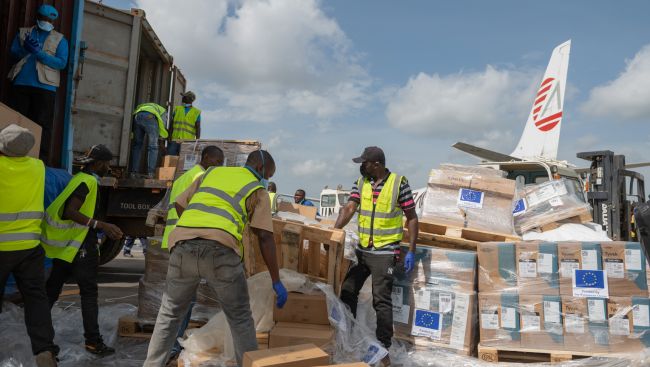
On Thursday, Canada also announced it will provide $8 million to the World Health Organization, the Africa Centres for Disease Control and Prevention, the Canadian Red Cross and other organizations to help them respond to the outbreak.
"It is absolutely crucial that we, as global partners, stand with our neighbours near and far to collectively confront this Ebola outbreak. Diseases do not respect borders," Michel said.
Picture Courtesy: AP Photo/Moses Sawasawa