

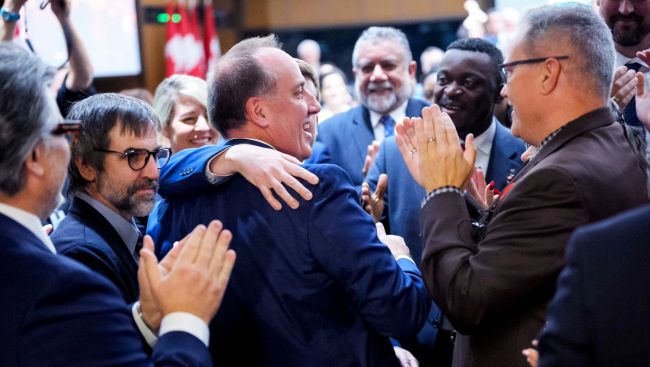
Nova Scotia MP Chris d'Entremont surprised many on Tuesday when he left the Conservative caucus to join the Liberals, bringing the government caucus to within two votes of a majority.
While switching parties between elections — a practice known as floor crossing referring to physically crossing the floor of the House of Commons to sit with a different caucus — is a controversial practice. More than 300 members of Parliament have changed parties while in office since 1867.
The first known MP to cross the floor was Stewart Campbell, a Nova Scotian who, in 1868, left the Anti-Confederates for the Liberal-Conservatives under Sir John A. Macdonald. The Dictionary of Canadian Biography says Campbell was later pelted with eggs at a "social occasion."
Library of Parliament data shows in the last 25 years, there have been 80 MPs who changed party affiliations between elections. Often times it came following a change in leadership, or sometimes a complete overhaul of the party itself.
In September 2000, Quebec MPs David Price and Diane St-Jacques left the Progressive Conservatives to join the Liberals, announcing their decision just after Joe Clark won a byelection to return to the House of Commons as the leader of the PCs. They said it was to prevent their seats from going to the Bloc Québécois.
Former Progressive Conservative MP André Harvey, who had left the party to sit as an Independent months earlier, also joined the Liberals later that month.
In 2003, days after the vote that merged the Progressive Conservative party with the Canadian Alliance to form the modern Conservative party, Progressive Conservative MP Scott Brison crossed the floor to the Liberals, saying the party better reflected his personal values.
Brison, Canada’s first openly gay federal cabinet minister, said he struggled with the merger and the fact that the PC party he grew up with no longer existed.
Belinda Stronach, who ran for the leadership of the new Conservative party in early 2004, crossed the floor to the Liberal party in 2005. She said that then-Conservative leader Stephen Harper wasn't sensitive to the needs of all parts of the country.
In 2006, David Emerson jumped to the Conservative bench just two weeks after he won a federal election as a Liberal. Emerson accepted a role as a minister in Prime Minister Stephen Harper's first cabinet. His move led to an inquiry by the Office of the Ethics Commissioner, which found that no rules were broken by either Emerson or Harper.
Leona Alleslev crossed the floor from the Liberals to join the Conservatives in 2018. Alleslev said the Liberal government had not adequately addressed some of the challenges facing Canada, citing its handling of the economy, tax reform, foreign affairs, trade and military spending.
In 2021, Fredericton MP Jenica Atwin left the Green party to join the Liberals after winning the party's first ever seat in Atlantic Canada. Atwin said at the time there were too many distractions in the Green Party and that she wanted to work in a more supportive and collaborative environment.
Ontario MP Eve Adams crossed the floor to the Liberals in 2015. She said she no longer felt a part of the Conservative party, either "politically or intellectually."
Jenna Gasper, a research librarian at the Library of Parliament, said in an email that of the 307 MPs who have changed their political affiliation since 1867, 158 switched from one party to another and 149 were Independents either before or after changing affiliation.
The Angus Reid Institute released a poll on floor-crossing in 2018 which suggested Canadians were divided on the practice.
The poll suggested that four in ten Canadians believed that politicians should not be allowed to leave one party and join another between elections. Roughly the same number said the practice was acceptable.
The poll suggested that those opposed to floor-crossing were inclined to say MPs should be required to step down and re-contest their seats in byelections before switching sides.
The poll suggested those who supported the practice tended to prefer allowing members to continue their terms as Independents.
Shachi Kurl, president of the Angus Reid Institute, said floor-crossing doesn't happen very often but it's a controversial and divisive practice.
Kurl said constituents who voted for a party or a party leader, rather than the local candidate, can react angrily when their MP chooses to cross the floor. Kurl added that it's not uncommon for politicians who cross the floor to also bow out of running in a subsequent election.
"These types of moves are often one and done. It has the potential to be politically career-ending in that role," she said.
Picture Courtesy: THE CANADIAN PRESS/Justin Tang


