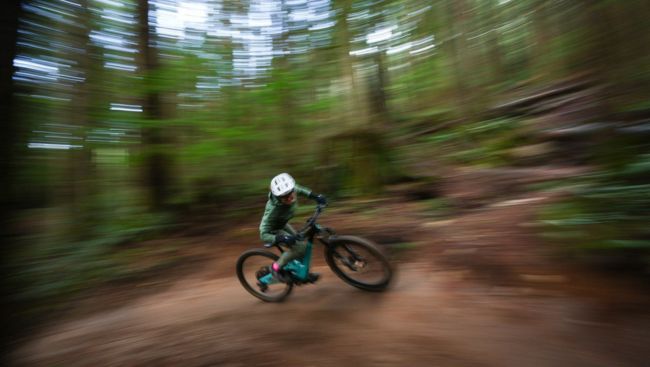
The outdoors were a refuge for many during the pandemic as people hit their local trail networks to mountain bike, hike, run and walk, but advocates in British Columbia say the value of trails isn't reflected in the level of support they receive.
Deanne Cote, executive director of the North Shore Mountain Bike Association, said no one could have anticipated the surge in people using the local trails.
"It's just kind of mind blowing," Cote said in an interview.
"It's a fine balancing act of well, the forest can only handle so much outdoor recreation, but there is so much pressure ... that we do need more capacity."
Martin Littlejohn, executive director of Mountain Biking BC, said trail networks offer a "huge opportunity" to attract tourists, while boosting community well-being.
But the bump in people using trails underscored the extent to which local, volunteer-driven groups like Cote's are stretched thin, he said, as they pick up slack to make sure trails are running smoothly and safely for everyone.
"We just need to build a better model to support what we have."
Littlejohn's advocacy group is now leading a study that aims to understand who is using the trails and how they're using them. Their goal is to push decisionmakers to support local trail networks and capitalize on what the sector has to offer.
Mountain Biking BC has received a grant of about $720,000 from the provincial government to conduct the trail-use study.
Littlejohn said B.C. has promoted itself globally as a leader in outdoor recreation and stewardship, including its reputation as a prime mountain biking destination, yet the sector sees little funding compared with other major industries.
"We talk about it, but I don't think our practices really sort of match the image that we try to create for ourselves," Littlejohn said of B.C.'s outdoor reputation.
The pilot study includes trail networks in Squamish, Golden, Fernie, Kamloops, Vernon and Cumberland, and Cote said her group is also contributing data.
Volunteers with Cote's group completed more than 10,000 hours of trail work last year, on top of about 8,000 hours of work by the paid crew, she said, describing them as the "eyes and boots on the ground" for the North Vancouver district.
Littlejohn's group has enlisted Farhad Moghimehfar, a professor at Vancouver Island University, to lead the study, which will use a combination of high-level mobile data along with surveys and interviews to understand who is using trails.
The study is not focused specifically on the economic impact of mountain biking and trails, which is a complicated analysis, said Moghimehfar, who serves as the B.C. regional innovation chair for tourism and sustainable rural development.
Rather, he said the study will look at who is using the trails, how they're using them, where they are coming from, how long they're staying, and how the broader community perceives their local trail networks and mountain biking sector.
"With triangulation of all this data that we gather, we are going to provide meaningful reports to trail managers and to policymakers," he said.
Grant Lamont, a longtime mountain biking guide in Whistler who works with Mountain Biking BC, said he hopes the study will demonstrate the sector's value.
"We really want to be able to highlight and show the value of (trails) and how we need more stable, sustainable funding going forward."
Cote said the North Shore trail crew is out every day, keeping the trails clear of deadfall, vegetation and excess water, repairing damage caused by erosion, replacing aging wooden features and removing invasive species.
The crew has also been modifying trails for use by adaptive mountain bikes, part of the group's work to enhance inclusivity and accessibility.
Cote said funding hasn't kept pace with pressure on the trails, although her association recently secured an expansion for its fee-for-service agreement with the North Vancouver District for trail work on the slopes of Mount Seymour in addition to work it already does on Mount Fromme, two popular riding areas.
The group receives about $128,000 under the updated agreement, she said, while the annual fee for the club's roughly 3,500 members is $60.
Other groups would see less support, Littlejohn said, noting one challenge is that many trails are located on provincial Crown land, outside municipal jurisdiction.
Ryan Schaap with the District of North Vancouver said it does not track trail-use data, though it has heard anecdotal reports of more people using the trails.
The Metro Vancouver regional district, however, has recorded increases in several of the parks it manages on the North Shore, including a 25 per cent bump in visitors to the Capilano River Regional Park between 2019 and 2024, the district said in an email.
The increase was nearly 65 per cent at the Lower Seymour Conservation Reserve, which saw 500,000 visitors in 2019 and about 823,000 last year, it said.