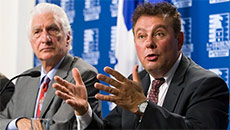
Tom Mulcair is refusing to take sides in the nailbiter referendum on Scottish independence.
But however it turns out, the NDP leader says the result will have to be respected.
"I think that it couldn't be clearer that international law has been very firmly respected here, there's been clear negotiations on everything from the question to the information that had to be put forward and the final decision is simply with the Scottish people," Mulcair said Wednesday.
Polls suggest the Sept. 18 referendum is going down to the wire with the Yes and No camps in a dead heat — reminiscent of the 1995 referendum on Quebec independence which came within a whisker of breaking up Canada.
Prime Minister Stephen Harper waded into the Scottish referendum debate last week while in London, telling a business audience it was not in the "greater global interest" for the United Kingdom to break up. And he drew a direct link to the separatist movement in Quebec.
"What would the division of a country like Canada, or the division of a country like the United Kingdom, do to advance solutions to any of these issues?" Harper asked, pointing to global challenges such as terrorism and climate change.
Alex Salmond, the Scottish First Minister, this week derided Harper's intervention as a sign of desperation on the part of U.K. Prime Minister David Cameron and the No camp.
Mulcair said he's "going to avoid doing the same" as Harper.
"I think that in instances like this, you're better off leaving people in another country to make their own decisions. I think that the British have all the tools at their disposal to make all the interventions that they want in the current referendum process and Mr. Salmond seems more than capable of responding as things roll out."
That said, Mulcair, who fought on the No side in Quebec's two referendums, volunteered that "senior representatives" of the U.K.'s Scotland office asked to meet with him last April when he was in London.
"They knew my experience in the two Quebec referenda and they wanted to talk about messaging," he said.
Mulcair acknowledged that some might try to use a Yes vote in Scotland to reignite the currently moribund separatist movement in Quebec. But he cautioned against drawing parallels with independence votes in other countries.
He noted that the Spanish region of Catalonia is facing its own independence referendum in November but said that it's "going to be a completely different kettle of fish." Among other things, the Spanish courts have ruled the referendum process unconstitutional.

Mulcair is evidently unfazed by the spectre that the Scots could vote to secede by a razor thin margin. Indeed, he noted that the NDP has proposed the "unity act" to deal with such a scenario recurring in Canada.
The unity act spells out that a bare majority of 50 per cent plus one vote would be sufficient to trigger negotiations on Quebec's secession, provided that the referendum question was clear and there were no "determinative irregularities" in the vote.
"The NDP has taken the time to put something solid and clear on the table ... We're very comfortable with the position that has the support of all elements of our caucus, wherever they're from in Canada," Mulcair said.
The NDP has designed its unity act to replace the Clarity Act, introduced by Jean Chretien's Liberal government after the near-death experience in 1995.
The Clarity Act specifies that the federal government will not negotiate secession unless a clear majority votes Yes on a clear referendum question. It does not specify what constitutes a clear majority, allowing parliamentarians to take into account voter turnout, voting irregularities and other factors before concluding whether the result is sufficiently unambiguous to warrant divorce talks.
Mulcair offered his comments on the Scottish referendum outside an NDP caucus retreat to plot strategy for what New Democrats believe will be a year of non-stop campaigning ahead of the next scheduled federal election in October 2015.
The party unveiled an election slogan aimed at reasserting its claim to be the real alternative to Harper's Conservative government: "Change that's ready."
The slogan is meant to contrast Mulcair's experience and his party's policy depth with what New Democrats see as the empty promises of neophyte Liberal Leader Justin Trudeau.
And it's consistent with the party's decision to begin unveiling key planks of its election platform a full year before the actual campaign begins.
"People are tired of talking points, they're fed up with partisan attacks. They don't want empty phrases and platitudes, they want things that are real," Mulcair said.
Among other things, the party intends to nail down platform planks on funding health care, creating a national child care program and reinstating a federal minimum wage.
The risky strategy could give rival parties a chance to trash NDP proposals or steal the best ones. But New Democrats are hoping it will remind Canadians that the NDP is the real contender for power, not the Liberals, who've been leading in opinion polls since Trudeau took the helm 18 months ago.
In a brief speech to his 96 MPs, Mulcair asserted that Canadians are for the first time looking at the NDP as a government in waiting.
Since vaulting past the Liberals to become the official Opposition in 2011, Mulcair said New Democrats have been "showing Canadians that we are ready to take on Stephen Harper's Conservatives and they now know this team does have the leadership and the experience to form government tomorrow morning."
Nevertheless, some MPs betrayed frustration with the constant questions about why the NDP is trailing in third place in the polls if, as they maintain, Trudeau is such an empty vessel.
Charlie Angus, veteran NDP MP from northern Ontario, chose to respond to the questions with sarcasm, saying he's "literally terrified" to find that voters in his riding have tattooed Trudeau's name on their necks.
"In Kirkland Lake, you see a man like me running in fear for his life," he joked.