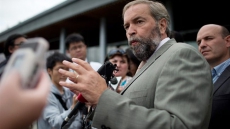
OTTAWA - Tom Mulcair is harkening back to the NDP's social democratic roots, casting his party as the champion of working class Canadians and the bane of what he calls corporate "freeloaders."
In a toughly-worded speech to be delivered today to a Teamsters rail safety conference, the NDP leader's rhetoric is reminiscent of the party's former leaders, particularly that of David Lewis who campaigned against "corporate welfare bums" in 1972.
Mulcair vows to continue fighting to end the exploitation of temporary foreign workers and unpaid interns.
"We're not going to stop until every worker is protected, whether they've been in Canada a day, a week, a year or a lifetime," he says in the text of the speech, obtained by The Canadian Press and to be delivered later today behind closed doors.
Mulcair promises to unveil this fall legislation to extend basic health and safety standards to unpaid interns and to ensure those who do the work of regular full-time employees get paid regular, full-time wages.
He also vows that an NDP government will pass anti-scab legislation and reiterates his recent promise to reinstate a minimum wage for workers in federally regulated sectors, ramping up to $15 per hour.
By contrast to the NDP's worker-friendly policies, Mulcair portrays Conservatives and Liberals alike as hostile to and contemptuous of the labour movement, which he credits with driving "the greatest reduction of inequality in human history" over the past century.
Meanwhile, he says Conservatives and Liberals have doled out "tax cuts by the billions" to the largest, most profitable corporations — cuts he has promised an NDP government would roll back.
"Today, the only ones in our society not paying their fair share are corporations," Mulcair says.
"They benefit most from our institutions, police, the courts, infrastructure, education. These are the institutions that helped them to get rich but now they want to stick someone else with the bill.
"There's a word for that: freeloader."
The tone of the speech is a contrast to Mulcair's vow during the NDP leadership race two years ago to move the party beyond "some of the 1950s boilerplate" language of social democracy in a bid to capture more centrist voters. At that time, he questioned why the party continually referred to "ordinary working class Canadians, ordinary this, ordinary that," calling it a recipe for restricting the NDP to a perpetual 17 per cent of the vote.
His shift in approach may reflect lessons learned from last spring's Ontario election or Monday's New Brunswick election, where attempts to cast the NDP as more centrist backfired at the polls.
Mulcair may also be trying to shore up the NDP's traditional base of supporters in the face of a reinvigorated Liberal party. Polls suggest the historic gains New Democrats made in the 2011 election have eroded steadily since Justin Trudeau took the helm of the Liberals 18 months ago.
Mulcair signalled earlier this month that he'll start rolling out platform planks this fall, a year ahead of the next scheduled federal election, in a bid to reassert the party's claim to be the real alternative to Prime Minister Stephen Harper's Conservative government. He's indicated that he'll focus on policies, such as a minimum federal wage and a national child care program, that seem designed to appeal to traditional NDP supporters.