

A new poll suggests that Canadians are feeling less anxious about losing their jobs as U.S. President Donald Trump continues to pursue his trade war with Canada and much of the world.
The Leger poll for The Canadian Press, which sampled 1,599 Canadian adults from March 21 to March 24, suggests that 38 per cent of employed Canadians are worried about losing their jobs over the next year.
That's the lowest percentage of respondents reporting employment anxiety in a Leger poll since Jan. 26.
Of those who told the new Leger poll they're worried about unemployment, 15 per cent said they "very concerned" and 23 per cent said they are "somewhat concerned."
Just days after Trump was inaugurated as president, just over a third of survey respondents told Leger they were concerned about losing their jobs within 12 months. That number spiked to 42 per cent a month later; last week, it stood at 41 per cent.
The most recent poll suggests that Ontarians are the most concerned, at 44 per cent. Only 31 per cent of people in British Columbia report worrying about losing their jobs to the trade war. Thirty-two per cent of Quebecers and 41 per cent of Albertans told Leger they're scared of losing their jobs.
Forty-three per cent of men and one-third of women surveyed reported worrying about unemployment.
Younger Canadians between the ages of 18 and 34 are the most concerned about losing their jobs, at 47 per cent, compared to 37 per cent of people aged 35 to 54, and 28 per cent of people aged 55 and older.
Sébastien Dallaire, Leger’s executive vice-president for Eastern Canada, said the poll results could indicate that Canadians are growing numb to the threats coming from the United States.
"It could be that right now there's a little bit of a calming down effect among Canadians," Dallaire said, noting that the "real hard economic impacts" are not yet visible.
The survey was conducted just days before Trump on Wednesday signed an executive order to impose 25 per cent tariffs on all automobile imports to the United States next week.
The deep integration of the North American industry is resulting in confusion about how those duties will affect the Canadian auto sector.
A fact sheet provided by the White House said automobiles imported under the Canada-U.S.-Mexico-Agreement on trade will only be tariffed on the value of content not made in the United States, and certain auto parts will likely see tariff delays.
Earlier this month, the president imposed 25 per cent tariffs on all steel and aluminum imports into the U.S., including Canadian products.
Bea Bruske, president of the Canadian Labour Congress, said Canadians' job concerns might be easing because the full impact of the economic crisis "hasn’t hit yet."
She said the drop in concern could also be due to a sense of solidarity among Canadians that is "giving people confidence that, together, we will get us through this crisis."
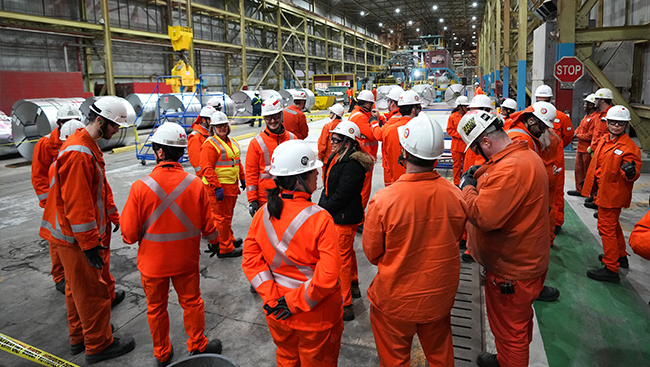
Noting that there have been hundreds of layoffs in the steel and aluminum sector already, Bruske said the threat to Canadian jobs and communities "remains very real." She said Canada needs leadership with "a clear vision" for the future that protects workers and pushes back against Trump’s threats.
The Leger poll suggests that Canadians' inflation concerns are on the rise.
The poll reports that 83 per cent of respondents believe that consumer prices have increased in the past few weeks, up eight points from mid-March.
Leger has been asking Canadians to rank the No. 1 issue facing the country. A Leger poll released earlier this month suggested that the trade war with the United States is the biggest source of political anxiety for Canadians, knocking inflation out of the top spot.
Dallaire said inflation and affordability have been hot-button issues in Canadian politics for almost two years.
"Donald Trump replaced concerns about inflation and affordability, but they didn't really disappear," Dallaire said, adding that people could also be anticipating the effects of tariffs on consumers.
"If people are starting to pay a bit less attention to Donald Trump, it's quite likely that they will come back to a focus on prices and affordability."
Picture Courtesy: THE CANADIAN PRESS/Nathan Denette


