

The NDP will return to the House of Commons without official party status at the end of May. The last time this happened was after the 1993 election — a time one former New Democrat MP remembers as "the Parliament from hell."
Svend Robinson represented Burnaby, B.C., in the House of Commons from 1979 to 2004. He said the party's devastating losses in 1993 led to a very challenging time in Parliament.
"I remember jumping up and down trying to get recognized by the Speaker from the very back corner of the House. We would get a few questions every week. That was it," Robinson said.
"Committees, we had no status on committees whatsoever. So it was the same thing there. You could show up at a committee hearing, and if the chair decided to recognize you, you might get a question or two."
In the last Parliament, the NDP enjoyed the right to ask questions daily in question period and held a seat on each House of Commons committee.
It lost those privileges when it elected only seven MPs in the general election last week. Official party status requires a minimum of 12 members of Parliament.
Robinson said the NDP caucus wasn't able to exert "any significant pressure" on federal government policy over those four years from 1993 to 1997.
In a Wednesday news release, the NDP said it plans to "strategically use the balance of power it holds to push the government to deliver real results for people."
Its priorities include advocating for "truly" affordable housing, expanding health care and "fighting for good jobs and better wages."
While the 1993 NDP had to operate in a Parliament with a Liberal majority, Prime Minister Mark Carney presides over a minority government.
Jonathan Malloy, a political science professor at Carleton University, said he expects the NDP will wield some bargaining power, even though Carney has ruled out a formal working arrangement.
"It's hard to know how much the Liberals want to do business with them. The Liberals can also do business with the Bloc Québécois. So the NDP would have a little bit of bargaining power, but not much," he said.
The NDP's loss of official party status also means a significant reduction in financial resources.
The New Democrats will miss out on millions of dollars in funding afforded to political parties that have more than 12 members in the House of Commons.
The baseline funding for an opposition party leader's office is around $1.1 million, which increases depending on how many MPs are in that party's caucus.
For example, the office of Andrew Scheer, the interim official Opposition leader in the House of Commons, will have a budget of nearly $1.3 million because the Conservative caucus has more than 101 MPs. Bloc Québécois Leader Yves-François Blanchet's office will receive baseline funding because there are only 23 MPs in his caucus.
Malloy said this lack of access to institutional funding will create a host of challenges for the NDP.
"It's really hard to act cohesively the party. You have enough resources to operate as individual MPs, and that includes serving your constituency … but there's just there's nothing for the overall big picture stuff," he said. "They're going to really struggle to do more than the bare minimum."
The NDP also will not receive funding to pay for House officer roles in their caucus, such as whip and House leader. The minimum budgets for those offices are around $148,000 and $111,000 respectively.
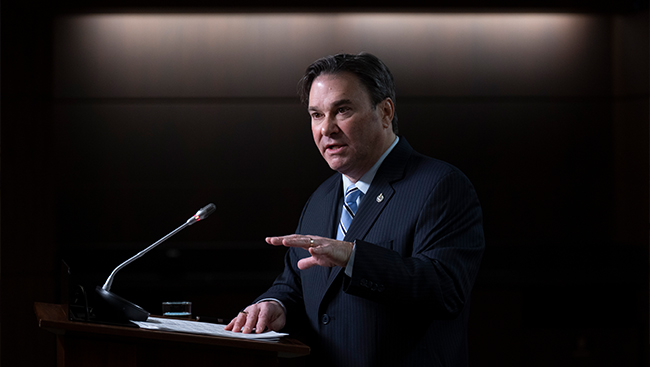
Interim NDP leader Don Davies said he's committed to an open, grassroots review of the election result that will guide the party's future direction.
“We need to take a hard look at how we got to where we are, and we need a clear view of where we're going,” Davies said in a media statement. "We need to reconnect with working people and show them that the NDP is their party, the one that fights and delivers for them.”
Robinson said his best advice for New Democrats operating in this new reality is to remember that much of an MP's job takes place outside Parliament.
He said that after losing seats in once-safe NDP ridings in Ontario and B.C., the party needs to reconnect with its traditional bases of support in the labour movement and progressive organizations.
"You obviously have to fight the good fight (in the House of Commons), but rebuilding the party is going to take place community by community, riding by riding, and strengthening … the grassroots of the party, which sadly have been allowed to largely wither and die," Robinson said.
Picture Courtesy: THE CANADIAN PRESS/Adrian Wyld


