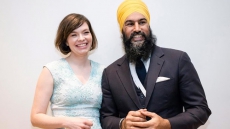
In a statement posted to the NDP website, Singh is defending his decision to attend a June 2015 rally in California — an event billed as a commemoration to the 10,000 Sikhs who died during an invasion of the Golden Temple in 1984, but which also became a show of support for Sikh separatism.
Singh says he has long been an advocate for human rights, but while he believes in allowing the Sikh community space to process the feelings inflicted by the trauma of the 1984 invasion, which he calls a genocide, he does not condone violence as a response.
He says his response to the events of 1984 has been to embrace his identity and work to ensure marginalized voices are never silenced.
Jasmeet Singh spilling poison against India. And this is Canada's future PM. pic.twitter.com/vkUb4ljNr1
— Dipiya Dilawari (@Dipdil) February 15, 2018
Jagmeet singh wants khalistan. pic.twitter.com/EYmVQds27U
— Dipiya Dilawari (@Dipdil) February 15, 2018
Singh’s statement, which follows a report about the 2015 rally in the Globe and Mail, comes at a time of strained Canada-India relations, in part because of lingering Indian concerns that Canadian governments tolerate Sikh separatism and extremism by not speaking out against it.
Prime Minister Justin Trudeau’s recent visit to India became more of a diplomatic embarrassment than a peace-building exercise, although Trudeau did manage to make some headway, publicly condemning extremism and signing a joint security framework with India to counterterrorism and violent extremism.
My statement regarding an event I attended in San Francisco in 2015: https://t.co/qgCAnllAr2
— Jagmeet Singh (@theJagmeetSingh) March 14, 2018
FULL STATEMENT FROM JAGMEET SINGH, LEADER OF THE FEDERAL NDP:
I condemn all acts of terrorism in every part of the world, regardless of who the perpetrators are or who the victims are. Terrorism can never be seen as a way to advance the cause of any one group. It only leads to suffering, pain and death.
I have long been an advocate for peace and human rights in Canada and around the globe. It’s important to name human rights atrocities as I have done in order to expose them and ensure they do not happen again.
The 1984 Sikh Genocide in India was a horrific episode in which many thousands of Sikhs were ruthlessly murdered and thousands more were disappeared. In 2017, the Ontario Legislature recognized these events targeting a religious minority as genocide. During that time of persecution in the 1980s and 1990s, many Sikhs fled India and were accepted into Canada as refugees.
Sadly, the pain and trauma of those events could not be left behind in their country of origin. It affected the victims to their core and, as we’ve seen in other communities that have suffered similar violence, that trauma is often passed down through generations.
Much of my work has centered around trying to answer the question: how does a community move through pain and trauma in order to reach acceptance so that it can arrive peacefully at reconciliation? I have seen pain and anger and my approach has always been to give space to those feelings in order to work through them, but never to condone acts of violence.
A few years ago, I was invited to speak as a human rights advocate and attend an annual event in San Francisco that commemorates the Sikh Genocide of 1984. While there, I spoke directly about the pain in the community and my own path to learning about my heritage. When faced with the knowledge that your relatives were targeted for who they were, you are faced with the question of how to respond.
My response was to embrace my identity and work harder to stand up for human rights and not allow the voices of the marginalized to be made silent. That is a lesson that has helped me to empathize with the struggles of others. I encourage all those facing these tough questions not to fall prey to rage and violence, but rather to embrace your truth and move forward with love and courage. Admittedly, this is not a simple or easy process, but attempts to oversimplify these experiences will not advance the cause of reconciliation.
My belief in human rights includes a fundamental principle that is written into Article 1 of the UN Charter: respect for equal rights and self-determination. Questions regarding the future of India are not for me to decide. I am not a citizen of India or an Indian politician.
Self-determination means respecting the views of people in whatever country to choose their own path. I am focused on building a stronger Canada, a country where we tackle growing inequality, where we unlock the full potential of our citizens and where no one is left behind.