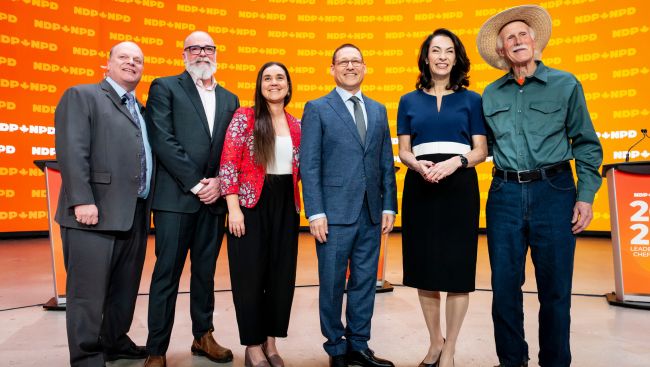
The memberships have been sold, entry fees have been paid and now the NDP leadership candidates are preparing for their second and final party-organized debate in B.C. on Feb. 19.
This second debate will be held in English. The first debate, held in November, was supposed to be a French-language debate — but since most of the candidates are not fluently bilingual, much of it was held in English.
While the candidates share a broad range of benchmark social democratic values — such as support for labour unions — the debate gives them a chance to distinguish themselves from their rivals.
The final vote will be held using a ranked ballot and the new leader will be announced on March 29 at a leadership convention in Winnipeg.
Here are some of the ideas the five leadership candidates are pitching:
Rob Ashton
This dockworker union leader is proposing a national public transit strategy with a dedicated $2 billion annual funding stream to help subsidize municipal bus and train fares.
Ashton also wants to build out national transportation infrastructure, including public buses and high speed rail, as a means to create jobs and cut emissions.
His platform calls for improved rail service to an expanded Port of Churchill in Manitoba to provide another avenue to ship Canadian products abroad.
Ashton's sovereignty messaging also includes a call for Canada to shift its defence procurement away from reliance on U.S.-controlled technology, such as the F-35 fighter jet.
Ashton also calls for replacing Canada's first-past the post electoral system with a form of proportional representation.
The exact form of that proportional representation, he said, would be determined by a citizens' assembly.
Tanille Johnston
The first Indigenous woman to seek the NDP leadership, Johnston puts reconciliation at the centre of her agenda. She calls for more federal investment in improving infrastructure in First Nations communities through things like all-weather roads, high-speed broadband internet and airports.
She has vowed a government led by her would eliminate long-term on-reserve boil water advisories, something promised by the Liberals in their 2015 election platform.
A central pitch in Johnston's platform is for a "guaranteed livable basic income" program to ensure every Canadian aged 18 to 64 can cover basic needs like food and shelter.
The guaranteed basic income model Johnston proposes would be scaled to taxable income, with the benefit shrinking as an individual's income rises.
In order to help pay for this, Johnston proposes increasing the corporate tax rate to 22 per cent from 15 per cent and taxing capital gains at the same rate as income.
Avi Lewis
Candidate Avi Lewis, currently leading the fundraising race among the contenders, is also running on tax reform. He wants to introduce a new one per cent "wealth tax" on individuals with more than $10 million in the bank, which would rise to a three per cent tax on net wealth over $100 million. Lewis has said this measure would pull in $40 billion annually.
Lewis also has pledged to end government subsidies to the fossil fuel sector and to stop the practice of hiring private consultants to advise the government.
The government terminated its digital services tax for certain social media and online advertising activities last year in response to opposition from U.S. President Donald Trump.
Lewis has said he would push to bring this back if he becomes NDP leader, adding it would generate $7 billion annually.
A Lewis-led NDP would call for a "human guarantee" that would ensure that people can choose to engage with a human being — instead of AI — when accessing federal services.
Lewis is also proposing broader regulations on AI, including a requirement that Canadian companies disclose their AI training data sets.
Heather McPherson
The only sitting MP in the race, McPherson is making rebuilding the party and running more competitive candidates the focus of her campaign.
She has called for more robust regional campaign infrastructure, earlier candidate nominations and enhanced communication between the central party and candidates.
McPherson also is campaigning on a plan to build a green economy by, among other things, shifting the focus of the Major Projects Office to prioritize a countrywide electricity grid and low-carbon power generation.
McPherson has said she also wants to introduce long-term, predictable funding for municipalities and residents to build infrastructure to respond to natural disasters like floods and wildfires that are made more common by climate change.
McPherson also wants to see all provinces and territories meet or exceed the federal industrial price on pollution.
Like Lewis, McPherson wants to end federal subsidies for oil and gas companies.
Tony McQuail
This Ontario organic farmer bills himself as a "green progressive" and argues pushing for sustainability is no longer a sufficient answer to climate change.
McQuail has said he'd bring his regenerative farming expertise to policies on restoring local flora to inactive industrial sites, roadsides and backyards.
He has called for a housing market that emphasizes affordable, communal and sustainable housing arrangements.
He also wants to see a non-profit ride-share program introduced to help rural residents get in touch with services in larger communities.
Like Johnston, he wants to see Canada adopt a universal basic income.
McQuail has said his platform has no chance of getting traction in the current electoral system, which is why he wants to see the first-past-the-post electoral system scrapped in favour of proportional representation.
Picture Courtesy: THE CANADIAN PRESS/Christopher Katsarov