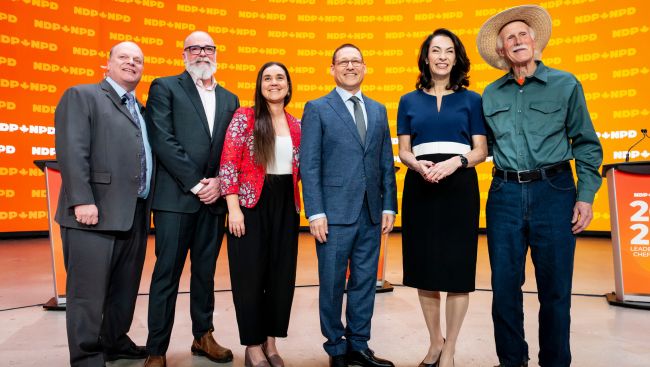
The NDP leadership candidates began the final official debate with a general acknowledgment they agree on policies, but have different visions for how to achieve their most existential goal — rebuilding the party.
At the close of the debate, each candidate was asked if they are running to rebuild the party or become the prime minister. Four of the five candidates said they are running to rebuild the party, while Ontario organic farmer Tony McQuail was the lone candidate who said he is eyeing the Prime Minister's Office.
During opening remarks in the Vancouver-area debate, Alberta MP Heather McPherson said the party needs someone who knows how to turn NDP policies and values into electoral wins. She said she has a track record of beating Conservatives in her home province and can expand that nationally.
Following the debate, she said that the NDP has always been the party of "big ideas" but to get them implemented you need get people elected.
"What we really need to do is look across the country and pick up seats where we have lost support, and I think we can do that," McPherson said after the debate.
"I think there are many areas across the country where we have seen New Democrats are strong, where people actually thought they were electing — they were voting for something they didn't get," McPherson said after the debate, alluding to votes lost to the Liberals in 2025.
She then pointed to areas she sees as winnable for the NDP including Vancouver Island, Metro Vancouver and southern Ontario.
Documentarian Avi Lewis said the same approaches seen in past elections will not work and the NDP needs to be putting forward big, bold ideas. He said this can be a winning strategy as his campaign has pulled in the most donations, nearly $780,000 as of Dec. 31, 2025, and is getting significant member support.
Lewis disputed the assertion that they all agree on what the NDP needs to do, and talked about his push for government-run options in groceries, telecoms and banking as a means of addressing affordability.
"We've raised almost as much money on our campaign as all the other campaigns combined, we have signed up new members in 338 out of 343 ridings and we have giant events packed with hundreds of people across the country. So something about our offer is resonating," Lewis said after the debate.
Dockworker union leader Rob Ashton disputed this, and said people need quicker fixes to address the affordability crisis and establishing these new Crown services will take too long.
Ashton said in his opening statements that the party needs to go back to its working-class roots if it wants to try and win back ridings that it lost in the last election to the Conservatives and Liberals. Ashton said that without that support, their ideas will remain ideas.
He later took a shot at Lewis for his authorship role in the Leap Manifesto, saying it killed the Alberta NDP's chances of being re-elected under former premier Rachel Notley.
"The part that I disagree with is not communicating with the provincial NDP, the Alberta NDP, before bringing it forward, before dropping it on the table in Alberta," Ashton said after the debate.
"Because that's when the sitting government, sitting NDP government had to fight and defend themselves."
Lewis defended the Leap Manifesto saying it had wide union buy-in and was adopted as a resolution by three-quarters of NDP members as a federal policy resolution at the party's 2016 convention in Edmonton.
McPherson said that the party only agreed to look at the Leap Manifesto and it gave provincial conservative leaders, including former Saskatchewan Premier Brad Wall, a cudgel to beat the NDP with.
Social worker Tanille Johnston opened the debate saying that she is honoured to be the first Indigenous person to be on a federal leadership ballot.
She said Canada needs to bring in a universal basic income to pull people out of poverty, end fossil fuel subsidies and have proper government-to-government relations with Indigenous communities.
Johnston said that the party and leader need to physically go to more places they don't have seats, speak to people and more importantly listen to those community needs.
"Not going to the places and spaces where we have big opportunities is not helping us. Prince Albert, huge opportunity in Prince Albert, (Sask.) and a lot of people might not see that. Prince Albert has a very high Indigenous population and people tell me all the time well Indigenous people don't vote," Johnston said during the debate.
"I'm like 'well have you had a gone and had a conversation with them?' … No we haven't."
McQuail said Canada needs a radical societal reworking to address climate change and the affordability crisis. He said Canada needs to redistribute wealth and shift the country's capitalist, consumer society to a more sustainable system.
"We have to talk about how do we not only change the economy and transition it to renewables, but how do we redesign to drastically reduce the amount of energy and resources that economies use," McQuail said during the debate.
"Because our economic growth, which has been promoted for the 45 years since I got involved in politics is actually becoming a cancer on the planet."
Yves Engler, a Montreal activist who was not allowed to run in the race, and a small group of protesters tried to enter the studio during the debate. They banged on the doors, shouting "Let us in!"
Local police arrived at the studio in New Westminster, B.C., to remove the protesters.
The broadcast of the debate was not interrupted by the protest.
Engler had promised to disrupt the race after his candidacy was not approved.
The race will be decided through a ranked ballot vote. Voting opens on March 9 and closed on March 28 at 7 p.m. Voters will be able to cast their ballot online, by phone or mail.
The next NDP leader will be announced on March 29 during the party's convention in Winnipeg.
Picture Courtesy: THE CANADIAN PRESS/Christopher Katsarov