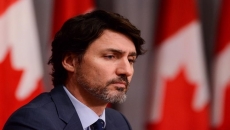
Legislation that Prime Minister Justin Trudeau said "cements" his promise to mostly eliminate greenhouse gas emissions within 30 years has been introduced in the House of Commons.
"This is an ambitious goal," Trudeau said Thursday morning in a virtual address at a conference as part of the Asia-Pacific Economic Co-operation forum.
"But our kids, our economy, and our future can afford nothing less. Net-zero is as much about avoiding the worst impacts of climate change as it is about creating good jobs and a competitive economy for years to come."
Watch live: Prime Minister Justin Trudeau, joined by Ministers Jonathan Wilkinson, Steven Guilbeault, and Catherine McKenna, makes an announcement. https://t.co/hyNSEhv0vd
— CanadianPM (@CanadianPM) November 19, 2020
The proposed legislation, Bill C-12, promises both transparency and accountability to get to net-zero emissions by 2050.
It fulfils a promise the Liberals made in the 2019 election to be more aggressive at cutting greenhouse-gas emissions.
It will require Environment Minister Jonathan Wilkinson to set five-year targets, starting in 2030, for curbing emissions on the way to net-zero emissions by 2050.
Net-zero means either eliminating all emissions or ensuring any still produced are absorbed by natural means like forests and wetlands, or technology like carbon capture and storage systems.
An emissions-reduction plan, progress report and assessment report on each would need to be tabled in the house, and the bill orders the environment commissioner to audit Canada's climate change mitigation measures at least once every five years.
The bill, if passed, would create an advisory body to help Wilkinson find the path to net-zero, and will require the minister of finance to report each year on what her department is doing to mitigate the financial risks from climate change.
Trudeau told the APEC forum that net-zero is "real" and is about both the environment and the economy. He said global investors are increasingly making decisions based on climate risk, and being greener is now a competitive advantage.
Canada has set multiple goals for curbing emissions over the last three decades and has never met a single one of them.
It missed its 2012 target under the Kyoto accord by more than 100 million tonnes and at the end of this year will miss its 2020 target by even more than that.
The difference is more than what Canada emits to heat and power the entire country.
Its Paris target is to reduce emissions by 30 per cent compared to 2005 levels by 2030. Current policies, including the carbon tax, banning coal power plants and regulating methane emissions in the oil and gas industry, will only get Canada about two-thirds of the way there.
Catherine Abreu, executive director of the Climate Action Network Canada, said she was more hopeful than she had been about the pending legislation, because the title of the bill has the words "transparency and accountability" in it.
She said to live up to its title, the bill will need to set specific carbon budgets for how much Canada can emit each year, decide where those emissions are going to come from, and then show the ways to hit those budgets.
It will also, she said, require an enforcement mechanism that isn't just about targets, but setting out who decides if they have been met and what happens if they are not.
"There is a difference between legislating a target and legislating climate accountability," said Abreu. "We need to fundamentally fix the way we do climate action in Canada because it is not working."