Friday, December 19, 2025
ADVT 
National

New Canadian modelling shows COVID-19 waning but relaxing restrictions still risky

Darpan News Desk The Canadian Press, 04 Jun, 2020 06:52 PM
  • New Canadian modelling shows COVID-19 waning but relaxing restrictions still risky

Canada's top doctor says the country has been successful at slowing the spread of COVID-19 but is warning that relaxing public health restrictions too quickly or too soon could lead to a rampant resurgence of the disease.

Dr. Theresa Tam presented a new report on the novel coronavirus in Canada, including new short-term projections that say between 157 and 1,857 more Canadians could die of COVID-19 in the next 11 days.

The projections, based on recent trends, estimate in the best-case scenario at least another 4,459 people will be diagnosed with COVID-19 by June 15, and in the worst-case scenario there will be more than 14,000 new cases by then.

"As Canada has experienced these outbreaks a lot has been learned," said Tam.

She said initial models were partly based on knowledge of how the virus spreads and what the known incubation period is, while these numbers are now based more on actual case data in Canada.

As of Thursday, Tam said, Canada has had 93,441 positive cases and 7,543 deaths.

Tam said most of the country has seen spread of the disease diminish substantially but there remain hot spots of community transmission in Toronto and Montreal that are concerning. In the last two weeks, Ontario and Quebec accounted for 90 per cent of new cases, and most of those were in those two cities.

She said as the country relaxes some measures, with more people returning to work and going out, it is critical to practice physical distancing, wear face masks and wash hands frequently. The health system also has to make sure it is keeping on top of testing and tracing new cases so patients can be identified and isolated as soon as possible.

The report says the longer-term outlook for the virus really depends on how well Canadians follow those practices. With a high degree of physical distancing, and case testing and tracing, Canadians can expect that the number of new cases will stay very low, including no real second wave in the fall.

With weaker controls, a surge of cases could see half of Canadians infected, with a rising number of cases throughout the summer and into next winter.

With no controls at all, as many as 80 per cent of Canadians will get infected by the end of the summer.

"It doesn't take very long for an outbreak to really gain some steam," said Health Minister Patty Hajdu.

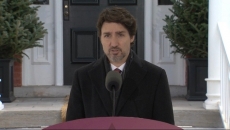
Prime Minister Justin Trudeau said earlier Wednesday he is encouraged by the overall trends in Canada but warned the country is not out of the woods.

Clusters of cases of COVID-19 have disproportionately affected institutional settings including long-term care homes, hospitals, prisons and meat plants. More than 80 per cent of deaths of COVID-19 in Canada are linked to long-term care and retirement homes.

Canada's largest single outbreak is linked to the Cargill meat-processing plant in Alberta, with 1,560 cases including workers, their family members and others in their communities.

MORE National ARTICLES

U.S. seals the deal on USMCA, says trade agreement can now take effect July 1

U.S. seals the deal on USMCA, says trade agreement can now take effect July 1
The United States has cleared the way for its long-awaited trade agreement with Canada and Mexico to go into effect July 1. The U.S. notified its North American trading partners today that it has finished the domestic housekeeping work called for in the agreement, a step the other two countries completed earlier this month.

U.S. seals the deal on USMCA, says trade agreement can now take effect July 1

Poultry plant in Coquitlam, B.C., closed by health authority over COVID-19

Poultry plant in Coquitlam, B.C., closed by health authority over COVID-19
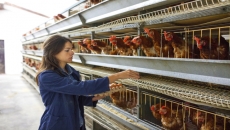
A poultry processing plant in Coquitlam, B.C., has been closed by Fraser Health after an outbreak of COVID-19 among its workers. The health authority says two workers at the facility operated by Superior Poultry Processors Ltd. have tested positive for the virus and all employees have been screened.

Poultry plant in Coquitlam, B.C., closed by health authority over COVID-19

Expectant mothers to get financial help: Feds

Expectant mothers to get financial help: Feds
Expectant mothers who have been left out of a key COVID-19 emergency-aid program will receive financial help, and will qualify for federal benefits when they go on maternity leave, says Canada's employment minister. Pregnant women who applied for employment insurance at the outset of the pandemic have found that they weren't automatically transferred over to the Canada Emergency Response Benefit when it became available earlier this month.

Expectant mothers to get financial help: Feds

Trudeau unveils rent relief for small businesses hurt by COVID-19

Trudeau unveils rent relief for small businesses hurt by COVID-19
The federal government is providing rent relief to businesses that can't afford to pay their landlords at a time when their operations are seriously curtailed or shut down due to the COVID-19 pandemic. The federal help, expected to lower rent by 75 per cent for affected small businesses, will be provided in partnership with the provinces and territories, which have jurisdiction over rents.

Trudeau unveils rent relief for small businesses hurt by COVID-19

Nova Scotia mass shooter had unlicensed guns: police

Nova Scotia mass shooter had unlicensed guns: police
Police say the man who went on a murderous rampage through five Nova Scotia communities was likely using unlicensed firearms, and investigators are trying find out how he obtained illegal weapons.

Nova Scotia mass shooter had unlicensed guns: police

PM suggests U.S. experience will inform Canada's plan

PM suggests U.S. experience will inform Canada's plan
Canada's federal and provincial governments will be watching closely for teachable moments as jurisdictions in the United States start to lift personal restrictions and reopen businesses in the wake of the COVID-19 pandemic, Prime Minister Justin Trudeau says. The best way forward will be informed by what works — and also what doesn't — as the U.S. and the rest of the world emerges from the crisis, Trudeau said Thursday during his daily briefing outside the front door of his Rideau Cottage residence.    

PM suggests U.S. experience will inform Canada's plan