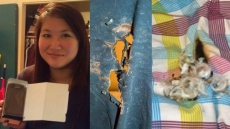
VANCOUVER — Enduring 180,000 bites is the scientific price a British Columbia biologist had to pay so her team of researchers could suck a little life out of the worldwide bedbug epidemic.
A team of biologists, a chemist and students from Simon Fraser University in Burnaby, B.C., announced Monday that they have identified a set of chemicals that can lure bedbugs into traps and keep them there.
The findings are significant because the pests, which were once thought eradicated in industrial countries, have reappeared over the past two decades, infesting everything from low-income housing to pricey hotels and causing health concerns, too.
Biologist Regine Gries, who with her husband Prof. Gerhard Gries, form part of the team, said she was initially a little reluctant and disgusted to act as a host so the pests could feed and scientists could gather and analyze the bugs skin and feces.
She said she got over those feelings because she, unlike others, was resistant to the bites.
"I calmed myself down thinking when human beings were still living in caves, they were probably bitten by bedbugs, by fleas, by mice and who knows what, all these insects associated with humans," she said. "So I think humans can endure this, and I'm lucky enough that I have no side effects, that I just can handle it."
Not only can bedbug bites cause rashes and itching, but a recent study linked them to Chagas, a disease that can cause serious heart and digestive problems in those who are infected, said SFU Chemistry Prof. Robert Britton, who is also a team member.
The team is now working with a company based out of Victoria, B.C., to develop the first effective and affordable trap to detect and monitor infestations.
The discoveries were made in three separate phases and began when the Gries and their students began the research about eight years ago.
Gerhard Gries said they initially found a pheromone blend — chemical substances secreted by animals for detection — in the skin of bedbugs. He said they attracted the pests in lab experiments but not in infested apartments.
He said the researchers realized a component was missing. Britton joined the team and used the university's state-of-the-art spectrometers to study the chemicals Regine Gries found in the bedbugs' shed skin.
Britton, the Gries and their students then discovered a histamine, a molecule that had previously eluded researchers, signalled a "safe shelter" to the bedbugs, meaning once they came into contact with it they remained in place.
Gerhard Gries said his wife further studied the bedbugs' feces and found three new components. He said the combination of all the components and the histamine became the lure they sought.
He said bedbugs are lured to the trap by the airborne components, and once they come into contact with the histamine, which is placed on a piece of filter paper, they remain put.
Britton said the trap's chemical costs are just under a dime.
Gerhard Gries said a cardboard box served as a trap during the experiments.
"One of the real benefits of this new technology will be that it is effective and affordable," he said.
The research has been published in the leading chemistry journal Angewandte Chemie, and was funded by a grant from the Natural Sciences and Engineering Research Council of Canada in partnership with Contech Enterprises Inc.