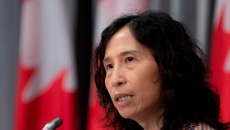
Canada's international trade minister is making her country's best case for being a central player in American efforts to recover from the COVID-19 pandemic.
Mary Ng is taking part in the inaugural meetings of the Free Trade Commission, which oversees the implementation of the U.S.-Mexico-Canada Agreement.
Ready to kick off today's #CUSMA Free Trade Commission meeting!
— Mary Ng (@mary_ng) May 18, 2021
✅ Discussions on the environment, labour and #InclusiveTrade
✅ Implementation of the new #NAFTA
✅ The first North American Free Trade Commission lead by women trade representatives! pic.twitter.com/EUOfkbVudm
Mexican Economy Secretary Tatiana Clouthier is also taking part in the meetings being hosted by U.S. Trade Representative Katherine Tai.
In her opening remarks, Ng says the pandemic drove home the importance of strong North American trade ties, supply chains and relationships.
She says the new trade agreement will be the foundation for a more competitive North America and a safe, stable and predictable business environment.
Tai opened the meeting by emphasizing the importance of making sure the USMCA benefits "everyday people" in all three countries, and not just those already wealthy enough to capitalize on it.
We are affirming our commitment to work together to support North America’s competitiveness, and to help build a safe, stable and predictable business environment.
Neither opening statement made any mention of the long-standing trade irritants that exist between Canada and the U.S., complaints that figured prominently in the pre-meeting conversations between the two on Monday.
In those discussions, Ng raised Canada's concerns about President Joe Biden's protectionist Buy American measures, pressed for a deal on softwood lumber and warned against shutting down the Line 5 pipeline.
Coincidentally, as Tuesday's meetings were taking place, Biden was singing the praises of his economic recovery strategy in Michigan, where he again insisted he would aggressively enforce efforts to make sure U.S. tax dollars benefit U.S. workers.
"I'm not (granting) a single contract to a single company that does not hire Americans, have all-American parts and has a supply chain that is an American product supply chain," Biden said.
"That's not violating any trade agreements. It's been the law since the 30s, but no one's had the courage or the nerve to insist on it being applied."
For her part, Tai has said she wants Canada to provide American farmers their promised fair access to the Canadian dairy market, and also flagged Canada's proposed three per cent digital service tax.
Dairy is widely expected to be a hot topic during the meetings: the U.S. served notice in December under the USMCA that its producers are being denied rightful access to a share of the Canadian market.
At issue is how Canada has distributed its tariff-rate quotas — the quantities of certain dairy products like milk, cheese, powders, yogurt and even ice cream that can be imported at lower duty levels.
U.S. trade officials and dairy industry advocates say a large share of those quotas have been allocated to processors rather than producers, denying U.S. farmers the access to the supply-managed Canadian market the USMCA is supposed to deliver.
Canada, meanwhile, has insisted there is nothing wrong with the way it has allocated the quotas.
The meetings are supposed to focus on fortifying supply chains, enforcing the agreement's labour and environmental protections and mitigating the economic effects of climate change.
But they could also provide a glimpse into which of the bilateral sore spots are likely to grow more painful in the coming months and which could see progress.
Tai is under mounting pressure to lift U.S. tariffs on Canadian softwood, a long-standing measure that reflects the American view that Canada's forestry producers are unfairly subsidized through federally set prices for Crown timber.
Former president Donald Trump's administration imposed a 20 per cent tariff on Canadian softwood in 2018, before the onset of the COVID-19 pandemic, but lowered it to nine per cent late last year after a decision by the World Trade Organization.
Lumber prices in the U.S. have tripled over the past year, thanks to pandemic-fuelled constraints on production and soaring demand for housing.
Canada has also been on Tai's radar over its proposed digital services tax, which is aimed at companies like Netflix, Amazon and Spotify, which deliver content to Canadian consumers digitally without having to pay levies paid by domestic service providers to support local broadcasting.