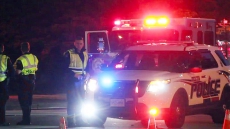
A Calgary police officer loudly tells an Indigenous man to put his hands on the roof of his car and, within seconds, the situation escalates to yelling. Body-worn camera video from the officer's chest then shows the man's head pushed into his vehicle.
Herbert Daniels, 67, made a freedom of information request to get the video of his arrest, which he provided to Global News, saying it demonstrates excessive force.
Using the arrest of Daniels as an example, many politicians have been calling for wider use of police body cameras in the wake of global protests calling to defund police, claiming the technology increases accountability.
There is, however, no consistent evidence that the cameras reduce police violence.
A study in the Criminology & Public Policy journal published last year looked at 70 other studies into body-worn cameras and found the technology had statistically insignificant impacts on police and citizen behaviour.
"(Cameras) will not be an easy panacea for improving police performance, accountability, and relationships with citizens," the study said.
A trial published in the Proceedings of the National Academy of Sciences of the United States of America in 2019 also found the cameras "did not meaningfully affect" police behaviour on outcomes that include complaints and use of force.
A six-month study by Western Australia Police Force in 2016 actually found a small increase in use-of-force incidents when officers wore the cameras.
Minneapolis police officers involved in the May arrest of George Floyd were wearing body cameras as one of them knelt on the Black man's neck for several minutes and he died.
Data is still emerging in Canada about the efficacy of the cameras. Since 2010, many police forces have implemented pilot projects but most abandoned them later, saying they didn't provide value for what they cost to both purchase the devices and store the data. Calgary is the only large police force to so far adopt the technology for front-line officers.
A final report into an Edmonton pilot project, which ran from 2011 to 2014, said the cameras had a potential for positive outcomes. But it found concerns about policy and no quantitative evidence that the cameras had an impact on complaints against officers.
"Body-worn cameras not only create concerns about the public's privacy rights but can also affect how officers relate to people in the community, the community's perception of the police, and expectations about how police agencies should share information," the report said.
There have also been pilot projects in Toronto, Thunder Bay and Montreal. Montreal found the cameras had little impact on police interventions and there were significant logistical and financial challenges.
Some smaller forces have cameras for a few officers. Fredericton police have six and the force in Medicine Hat, Alta., has 10.
Recently, many communities have changed their positions on cameras. Toronto Mayor John Tory said he expects to have cameras on officers by the fall and Montreal Mayor Valérie Plante said the technology will be adopted as soon as possible. The RCMP has also committed to outfitting some officers with cameras.
Nunavut is pushing forward with a pilot project for cameras after a bystander recorded footage of police using a car door to knock a man over during an arrest.
Erick Laming is a Shabot Obaadjiwan First Nation PhD candidate in criminology at the University of Toronto. He also researches police use of force and oversight.
He said he's concerned the technology is being rushed by politics and not empirical data.
"We have to look at how police respond to (situations)," he said. "It's not really the body camera."
Laming said there isn't transparency about police force policies on cameras, such as ensuring public privacy, who gets access to the video or when officers are required to turn them on.
Sgt. Travis Baker leads the body camera project for the Calgary police, which has equipped about 1,150 officers with cameras.
City council originally approved $5 million to get the cameras and to fund an eight-year contract with Axon, an American company that supplies the gear and stores the data. All video is uploaded into a cloud-based storage system based in Ontario and only officers involved in an investigation get access to the video related to it, Baker said.
Before the cameras were rolled out, the Calgary force conducted a privacy impact assessment, Baker said. Broadly speaking, the policy says officers are required to record any interaction they have with the public.
An evaluation of the project is underway, with information about use-of-force and complaints to be released later this year. Baker, however, said all officers have embraced the technology.
He said the cameras hold police and the public accountable.
"We truly see it as a tool," Baker said. "It gathers evidence at a level that is unprecedented. It keeps absolutely everybody engaged and honest in the interaction."