Monday, December 22, 2025
ADVT 
National

Official languages commissioner sees complaints drop by more than half in past year

Darpan News Desk The Canadian Press, 07 May, 2024 11:06 AM
  • Official languages commissioner sees complaints drop by more than half in past year

The number of complaints from Canadians who say their language rights weren't respected dropped by more than half last year, but the official languages commissioner says it's too early to say there is a downward trend.

In his annual report released Tuesday, Raymond Théberge says his office received 847 admissible complaints between April 1, 2023, and March 31, 2024, down from 1,788 in the previous fiscal year. The last time his office received fewer than 1,000 complaints in a year was in 2017-18, when there were 894.

But he cautioned against drawing conclusions that violations of the Official Languages Act will continue to decline.

The 847 complaints, he told a news conference, "are a bit of a contrast to the very high volume we've become accustomed to in recent years. Is this decrease a sign that federal institutions are complying more fully with their language obligations? .... Only time will tell."

Théberge said some years elicit more complaints than others, such as in 2021, when Air Canada CEO Michael Rousseau caused an uproar when he delivered a speech in Montreal almost entirely in English, and when the prime minister appointed Mary Simon, who wasn't fluent in French, as Governor General.

The commissioner said Air Canada remains the institution most frequently targeted by complaints, but last year the number dropped to 130 from 276 a year earlier. "I think that still indicates that there are challenges with respect to Air Canada to meet their language obligations," Théberge said.

The commissioner's report criticizes "unco-operative institutions" that he says don't accept that they have to be able to serve Canadians in both English and French. At the news conference, Théberge refused to identify which companies, government departments or agencies he was referring to, only saying that the senior management of institutions must set an example and be aware of their obligations regarding the country's two official languages.

The two biggest categories of complaints in Tuesday's report involved communications with the public, with 533, and the language spoken at work, with 227.

"This year, we've had a higher number of complaints regarding the language of work," he said. "So, it's not only the travelling public, but also institutions within the federal government that face challenges in accommodating employees to use both official languages."

Federal institutions subject to the Official Languages Act include Air Canada, Via Rail, Canada Post, the Royal Canadian Mounted Police, and the CBC, as well as all government departments.


MORE National ARTICLES

Canada takes no clear position on interim ruling in genocide case against Israel

Canada takes no clear position on interim ruling in genocide case against Israel
Canada opted to say as little as possible Friday about an International Court of Justice ruling that ordered Israel to prevent a genocide of Palestinians in the Gaza Strip. After hours of silence from the federal government, Foreign Affairs Minister Mélanie Joly eventually released a statement that did not directly respond to the ruling.

Canada takes no clear position on interim ruling in genocide case against Israel

Canada suspends cash for UN agency serving Palestinians, amid probe into Hamas attack

Canada suspends cash for UN agency serving Palestinians, amid probe into Hamas attack
Canada is joining the United States in suspending funding for a UN agency that supports Palestinians, in response to allegations agency staff played a role in the Hamas attack on Israel last October.  Ottawa has ordered a temporary pause on "any additional funding" for the United Nations Relief and Works Agency for Palestine Refugees in the Near East.  

Canada suspends cash for UN agency serving Palestinians, amid probe into Hamas attack

Highway 99 closed overnight

Highway 99 closed overnight
Highway 99 in Richmond will be closed overnight for construction work on the Steveston Interchange project. The B-C Transportation Ministry says in a statement the highway will be shut down in both directions starting 11 p-m and ending Saturday at 4:30 a-m.  

Highway 99 closed overnight

B.C. Health Minister announces appointment of new seniors advocate

B.C. Health Minister announces appointment of new seniors advocate
B.C. Health Minister Adrian Dix says the province's new seniors advocate is Dan Levitt, an adjunct professor of gerontology at Simon Fraser University and the head of a non-profit long-term care home.  Levitt says he's "deeply honoured" to be appointed the province's second seniors advocate, and thanked current advocate Isobel Mackenzie, who is retiring in April. 

B.C. Health Minister announces appointment of new seniors advocate

Tackling Cyberbullying Digital Empathy in the Age of AI

Tackling Cyberbullying Digital Empathy in the Age of AI
The rise of social media platforms and online forums has connected people globally, fostering communication and collaboration. However, this interconnectedness has also opened the door to malicious behavior, with cyberbullying emerging as a formidable threat. Unlike traditional forms of bullying, cyberbullying transcends physical boundaries, allowing perpetrators to target individuals relentlessly through the anonymity afforded by the internet.

Tackling Cyberbullying Digital Empathy in the Age of AI

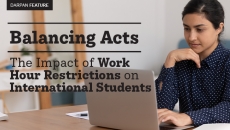
Balancing Acts The Impact of Work Hour Restrictions on International Students

Balancing Acts The Impact of Work Hour Restrictions on International Students
The Immigration and Refugee Protection Regulation stipulates that international students holding a study permit without a work permit are limited to working a maximum of 20 hours per week off-campus during the academic session, while they are permitted to work full-time during breaks between sessions. On-campus work has no hourly restrictions. Violation of this work cap, as outlined by the Government of Canada, may result in severe consequences, including the loss of student status, denial of approval for future study or work permits, or even deportation. 

Balancing Acts The Impact of Work Hour Restrictions on International Students